




What makes an airline offer modern? More flexible pricing is part of the answer. So are relevant products, effective distribution, and the ability to deliver what the customer buys.
For airlines that seek to modernize offers, bringing those capabilities together is where the work begins. And this is also where opportunities are born.
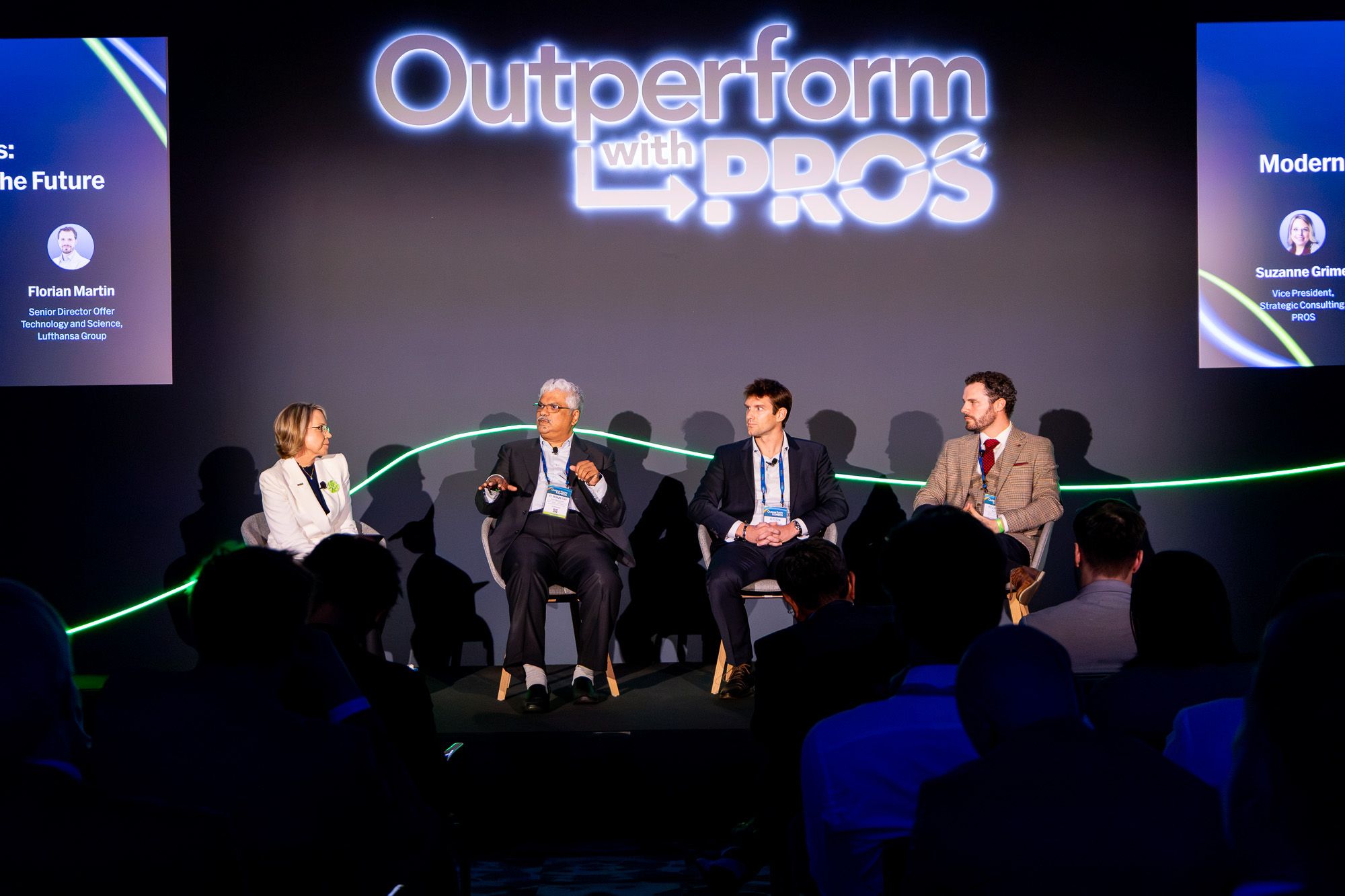
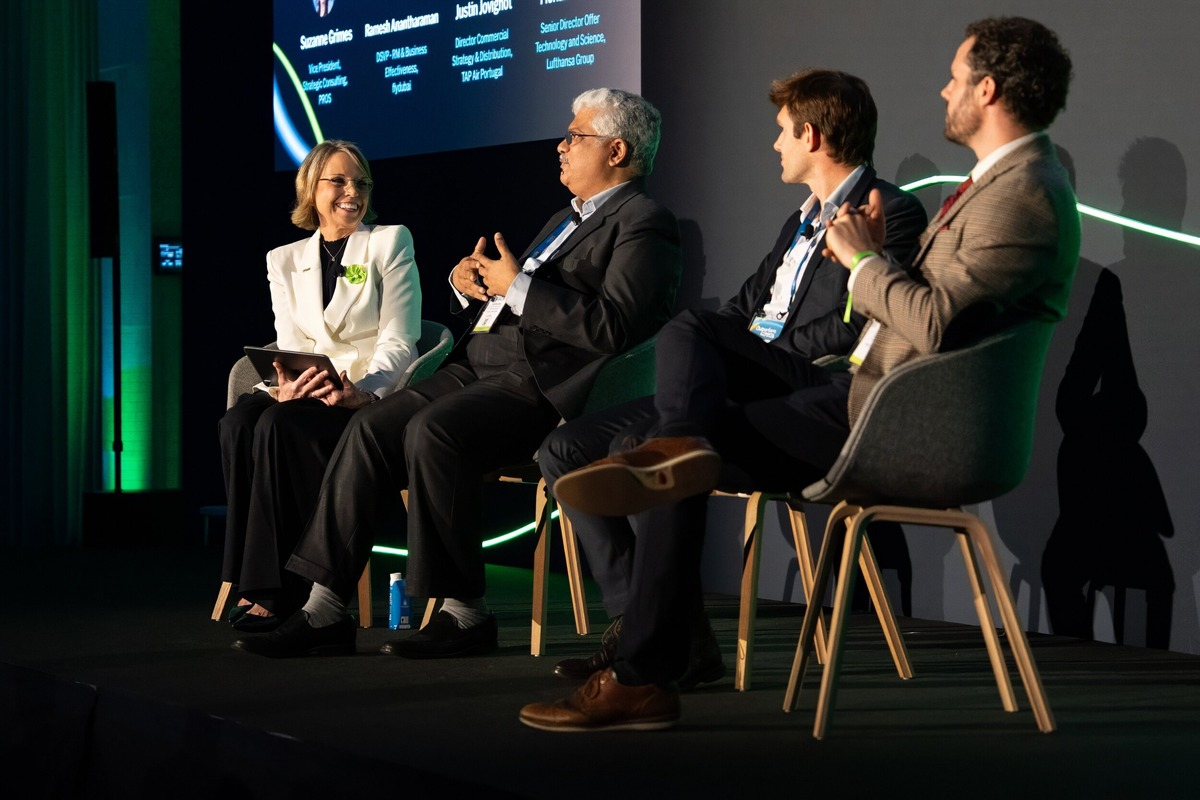
At the PROS Outperform 2026 summit, leaders from flydubai, TAP Air Portugal, and Lufthansa Group shared how their airlines are advancing that work. Moderated by Suzanne Grimes, VP, Strategic Consulting at PROS, the panel explored pricing modernization, distribution, organizational change, and the realities of operating across existing and emerging systems.
Their experiences revealed a common principle: progress starts with a clear commercial purpose.
Start with Flexibility, Control, and the Customer
Asked to define a modern offer, Ramesh Anantharaman, Divisional SVP, Revenue Management & Business Effectiveness at flydubai, identified two key priorities:
“I would pick two words: flexibility and control.”
For travelers, flexibility means access to products and bundles that fit their needs. For airlines, control means being able to price those products appropriately, manage inventory, and deliver the experience promised, Anantharaman said.
Justin Jovignot, Director Commercial Strategy & Distribution at TAP Air Portugal, described the shift as moving from selling seats at a price to selling combinations of products and services. That requires capabilities traditionally managed in separate systems to work more closely together.
“The idea with modern offers is to bring all those elements together to have better control on what we sell, at what price, and how we distribute it,” Jovignot commented.
Florian Martin, Senior Director Offer Automation at Lufthansa Group, emphasized the same need from the customer’s perspective. Travelers experience the schedule, price, services, and presentation together. Airlines therefore need to think more holistically about how they design, manage, and optimize the offer. In this context, technology is the enabler that helps bring these coherent customer experiences to life.
Make Progress Where the Business Case Supports It
The three airlines represented different starting points and transformation paths. However, each emphasized the importance of evaluating progress through its commercial contribution.
At flydubai, early decisions around distribution agreements and an in-house reservation system created flexibility for pricing innovation. The airline initially adapted an ancillary merchandising engine to support dynamic seat pricing, helping teams see the benefits before progressing to dynamic availability.
Anantharaman’s advice was to approach modernization with both a long-term view and a willingness to make progress one step at a time.
“But even while you are taking incremental steps, do not look for a perfect solution,” he highlighted.
Lufthansa Group’s experience reinforced the opportunity to move before the entire technology environment changes. Martin described continuous pricing as a foundation for further development, including more sophisticated demand-based pricing models and real-time pricing intelligence. For Lufthansa Group, delivering those capabilities within existing infrastructure required substantial effort. The decision to proceed depended on the business case.
For other airlines, the lesson is to assess what can create value now, what it will take to deliver it, and how that investment supports the longer-term direction. Modernization can generate commercial benefits while the broader transformation continues.
Develop the Organization Alongside the Technology
Pricing modernization also changes how people work.
In the case of flydubai, a central challenge was helping teams understand dynamic pricing and become comfortable with a different approach. Seeing the results helped establish confidence and made subsequent changes a more natural progression.
At Lufthansa Group, the evolution extends to how pricing roles are defined. Martin described a move toward “offer analysts,” with responsibilities spanning customer value, competitive positioning, and product experience. The aim is to help people think more broadly about the commercial decisions behind an offer, beyond the mechanics of managing filed fares.
“It takes time to bring an organization into this new world of modern offers,” Martin emphasized.
The organizational development must begin during the transition. Teams need opportunities to build skills, adjust processes, and apply new ways of thinking as capabilities become available.
For airline leaders, this makes adoption part of the business case. The value of better intelligence depends on people being able to understand it and act on it.
Connect Better Offers with Effective Distribution
A compelling offer needs a path to the customer.
TAP Air Portugal’s investment in NDC has given the airline greater control over what it makes available and the commercial conditions associated with different distribution channels. It has also changed conversations with travel agencies, with distribution capabilities, integration plans, and content availability playing a greater role in commercial relationships.
But better connectivity does not automatically translate into better outcomes. Success depends on whether partners can sell the offers efficiently and generate revenue.
Jovignot noted that modernization requires airlines to operate across direct channels, traditional distribution, and NDC connections simultaneously. Capabilities can vary across partners, including whether an offer can be serviced or refunded. And because agencies have their own business cases, investment priorities, and roadmaps, adoption takes time.
These realities reinforce an important point: distribution isn’t separate from offer strategy and must be treated as an essential part of it. Airlines need to consider how an offer will be presented, purchased, and supported across the channels customers use.
For TAP Air Portugal, this makes simplification an important goal.
“If there is an opportunity to simplify the business processes, I think we should take it,” Jovignot concluded.
Build for a Future That Is Always Changing
Looking ahead, Anantharaman pointed to AI shopping agents as an example of why agility matters.
An airline website may present a limited selection of bundles to help a traveler make a choice. An agent shopping on that traveler’s behalf could evaluate a much broader set of combinations. In this sense, airlines may need different ways to expose relevant products and respond to those requests.
Anantharaman’s point was that airlines should continually reassess how customer behavior and technology affect their commercial capabilities.
Martin raised a different risk: adopting new systems without fully using the opportunities they create.
“The bigger danger I see today for the next three to five years is that people are going to make the switch, but they’re still going to end up more or less doing today’s business,” he said.
The opportunity lies in enabling something better: more responsive pricing, richer offers, stronger partner integration, and experiences that would have been difficult to deliver before.
Turn Connected Capabilities into Commercial Value
The panel demonstrated that winning with modern offers is not about implementing a single technology or reaching a defined end state. It is about building the flexibility, control, and commercial intelligence needed to respond as customer expectations, distribution models, and market conditions continue to evolve.
That philosophy is central to PROS Kairos, the offer platform that helps airlines connect the capabilities required to define, optimize, construct, and market offers, while maintaining the freedom to evolve on their own terms.
For airlines planning their next step, the most important question is: where can we create more value now while building the flexibility to adapt to whatever comes next?
Explore PROS Kairos and discover how connected offer capabilities can support your commercial priorities.
____________________________________________________________
Best executive quotes for highlights and social
These are direct excerpts, with punctuation and capitalization lightly cleaned up. Longer, disfluent passages are avoided so the wording remains faithful to the transcript.
| Speaker | Quote | Best use |
|---|---|---|
| Ramesh Anantharaman, flydubai | “I would pick up two words, flexibility and control.” | Commercial independence graphic |
| Ramesh Anantharaman, flydubai | “The fundamental principle how you need to approach the modern airline retailing is do not think of it as a technology project.” | Main blog pull quote |
| Ramesh Anantharaman, flydubai | “Even while you are doing incremental steps, do not look for a perfect solution.” | Earn-while-transforming social post |
| Ramesh Anantharaman, flydubai | “Be flexible, be aware of where the industry is going and be agile.” | Future-readiness preview |
| Justin Jovignot, TAP Air Portugal | “The idea with modern offer is to bring all those elements together to have better control on what we sell, at what price and how we distribute it.” | Connected offer capabilities |
| Justin Jovignot, TAP Air Portugal | “We have the flexibility to control it and to decide.” | Short distribution-focused graphic; retain NDC context in caption |
| Justin Jovignot, TAP Air Portugal | “If there is an opportunity to simplify the business processes, I think we should take it.” | Operational simplicity post |
| Justin Jovignot, TAP Air Portugal | “The transition is not more expensive than what we think the benefit will be, because if yes, then the business case is dead.” | |
| Florian Martin, Lufthansa Group | “It takes time to develop an organization into this new world.” | People and organizational change |
| Florian Martin, Lufthansa Group | “The bigger danger I see today for the next three to five years is that people are going to make the switch, but they’re still going to end up more or less doing today’s business.” | Strong thought-leadership preview |
| Florian Martin, Lufthansa Group | “There is no excuse not to do continuous pricing in the legacy world. It’s a bit tedious, but much less tedious than what we experience today. And this is a no-regret move. You’re going to need it anyway.” | 26:50 |
| Florian Martin, Lufthansa Group | We think too much about the technology and the process that we must change. What is almost more important is the mindset that you change in your organization, and this is going to live on like this also when you’ve gotten rid of certain legacy processes. | 27:10 |