

When it comes to airline revenue management (RM), AI and forecasting strategies are always evolving. Not keeping pace with these changes jeopardizes your opportunities for revenue growth. This has never been so apparent and necessary as it is now – with the push toward modern airline retailing, which will give airlines the ability to regain retail control and commercial autonomy.
But how can you ensure you’re modernizing RM technology and talent to build a future-proof RM organization?
PROS Director of Airline Product Management Justin Jander sat down with a panel of PROS Revenue Management customers to discuss just that at PROS annual Outperform with PROS conference. Watch the full session on PROS.com here, and keep reading for a more in-depth look at 5 key considerations you should keep in mind when upgrading your RM system and ensuring it is future-proof for modern airline retailing.

- Invest in analyst training. In an era where data analytics and sophisticated algorithms play a pivotal role, well-trained analysts are the linchpin of effective decision-making. One of the most common mistakes companies make is investing in technology but not in people. By providing comprehensive training, airlines can better empower their analysts, who are potentially more junior following the pandemic, with the skills and knowledge necessary to extract actionable insights from vast datasets. Easy UI/UX and analyst-friendly workflows, while helpful, do not compensate for deep understanding and training.
Well-trained analysts can more quickly and effectively identify opportunities for revenue optimization, enhance forecasting accuracy, and devise innovative strategies to maximize revenue, and ultimately profits. Investing in the continued education and skill development of revenue management analysts not only sharpens the airline's competitive edge but also ensures the adaptive intelligence needed to navigate the industry’s ever-changing market dynamics successfully.
- Embrace AI and ensure you’re on a path to AI-driven RM. Investing in the latest RM technology and AI solutions is not just a choice; it's a strategic imperative. By leveraging AI-driven insights, airlines can accurately predict demand patterns, optimize pricing models, and enhance customer experiences. This proactive approach allows airlines to adapt swiftly to market fluctuations, tailor their offerings to customer expectations, and maximize revenue and profitability.
But, for some airlines, the AI adoption curve is daunting. And not all AI is equal. When it comes to selecting and implementing a path to AI-driven RM, airlines should look for an RM system with increasing technical advancements and functionality that drive value and prepares RM analysts and teams for more complex motions. Increasing sophistication in RM can roll out gradually as airline teams and operations grow and mature and their needs require more thorough RM decision support with AI. AI should also not be a black box – analysts need to understand what data is driving the recommendations, and how explain/interpret the forecast.
Embracing cutting-edge RM forecasting and AI not only streamlines operations but also future-proofs revenue management, ensuring airlines are not just competitive today, but resilient and agile in the face of tomorrow's challenges. Want to learn more about PROS AI in the airline industry? Watch PROS Chief AI Strategist, Michael Wu, Ph.D., talk about AI and its role in RM and customer-centric retailing.
- Build a pathway from RM to true offer optimization. Traditional revenue management used to be just about selling the right seat to the right passenger at the right time, but as the industry embraces modern airline retailing, and embarks on a path to offer and order management, airlines need to think beyond just RM to offer optimization:
- Does your airline have a solution to dynamically price not only the seat but also ancillaries?
- How are you advancing your dynamic pricing initiatives to embrace continuous pricing capabilities as well as context or request-specific pricing?
- Is your shopping or merchandising engine capable of ranking, bundling, and pricing seat + ancillaries?
Read more about Moving from RM to Airline Offer Optimization in this blog post.
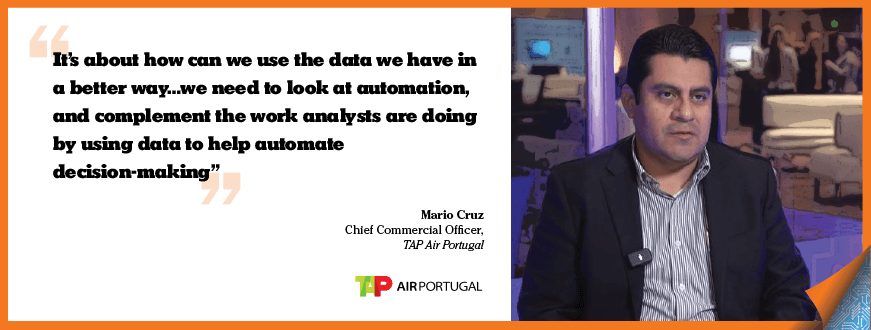
- Enhance data and work toward better data utilization and visualization for decision support. Data, its strategic utilization, and effective visualization are the cornerstones of modern airline revenue management. Airlines are inundated with vast amounts of data and leveraging this data intelligently is crucial for making informed decisions. It’s one of the biggest challenges facing airlines today – in addition to the complexity of legacy IT infrastructure.
Advanced analytics techniques allow airlines to mine this data for valuable insights, helping them understand customer behavior, predict demand patterns, and identify revenue optimization opportunities. Data utilization, when combined with sophisticated algorithms and machine learning models, enables airlines to optimize pricing strategies, allocate resources efficiently, and enhance overall operational efficiency. Moreover, data visualization tools play a pivotal role in translating complex datasets into intuitive visuals, enabling revenue managers to comprehend trends, spot anomalies, and communicate insights effectively. Clear, visually appealing representations of data empower decision-makers to identify actionable patterns promptly, enabling airlines to respond swiftly to market dynamics and customer preferences, ultimately maximizing revenue and ensuring long-term sustainability in the fiercely competitive airline market.
- Find ways to address IT roadblocks. It’s no secret that the airline industry faces significant IT roadblocks, with Passenger Service Systems (PSS) being a prominent challenge. Outdated legacy systems hinder airlines' ability to adapt to the rapidly changing demands of modern travelers and deliver customer-centric experiences and optimized offers. Additionally, IT talent shortages are also critical to address. Airline IT personnel are hard to come by, and its hard to recruit – the airline industry is extremely specialized and complex.
To combat these challenges, many carriers are investing in comprehensive digital transformation strategies, migrating from legacy PSS to modern, agile platforms. Cloud-based solutions and modular architectures are gaining traction, enabling airlines to scale operations efficiently. Now more than ever, as airlines look to build a future-proof RM system that will launch them into the world of modern airline retailing, it is more important than ever to partner with the right technology vendors to help fill those gaps.

Learn more about how PROS is supporting airlines on their path to retail freedom in the following blog posts:
- How to Achieve Airline Offer Optimization?
- The Commercial Imperative for Airline CCOs
- 3 Ways to Fast-track to Airline Retail Freedom