
Airline Mentions Are a Baseline, Not the Outcome
In AI search, airline mentions are often table stakes. For a given city pair, only a limited number of airlines offer relevant service. If a traveler asks for flights on a route, a carrier that operates it has a reasonable chance of being named.
Being named is not the same as being chosen as the path to book. PROS research across 376 city-to-city flight prompts found that 74.6% of airline mentions in ChatGPT were not linked to the airline’s own website. The brand received exposure, but the click went to an online travel agency (OTA), a metasearch site, Google Flights or another domain.
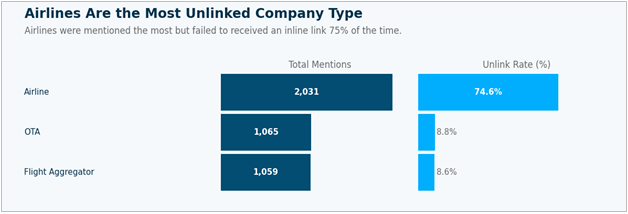
Mentions still reveal route association, brand awareness and competitive presence, but they are better treated as baseline metrics. The more consequential outcome is an airline-owned citation that gives the traveler a direct path to the airline’s flight page.
This framework covers three things:
- The controls, segmentation, tools and cadence needed to read the results.
- The citation and mention-to-link KPIs airlines should prioritize.
- How to build a prompt panel that gets AI assistants to actually answer a flight search, instead of asking follow-up questions.
Mentions vs. Citations
A mention means the airline’s brand name appears in the generated answer.
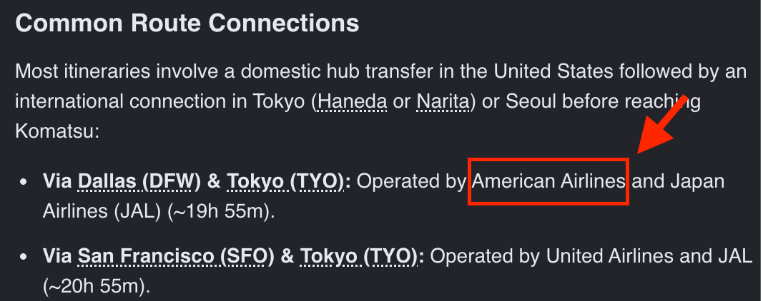
A citation means the answer contains a clickable airline-owned URL. Depending on the platform, that link may appear:
Inline, within the generated response.
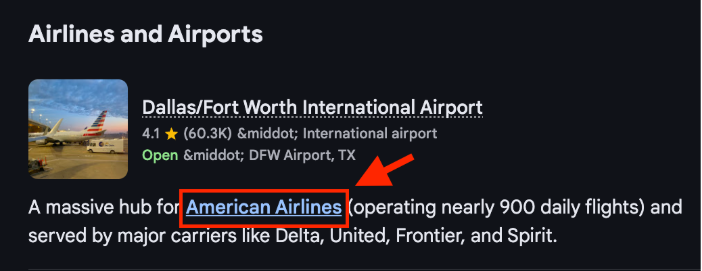
In a source or citation panel associated with the response.
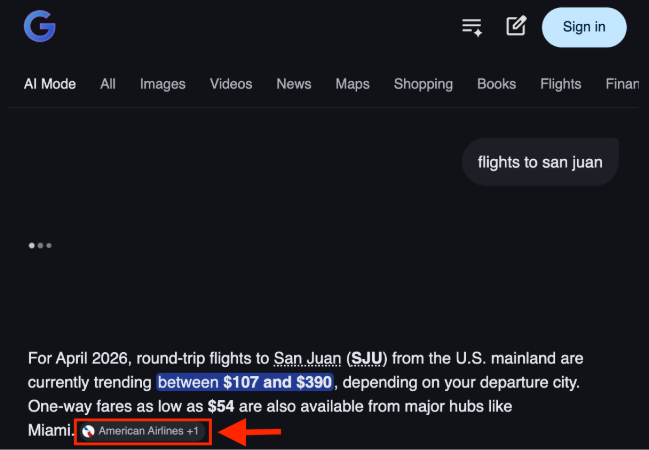
Mentions and citations can occur independently. An answer can name an airline without linking to it. It can also cite an airline-owned route page without naming the carrier prominently in the text.
Neither placement guarantees a click. A citation does create the possibility of a click, credits the airline as a source and gives travelers a direct path to first-party information. That makes citation performance the stronger leading indicator of airline-owned visibility.
First, Check That the AI Actually Answered the Flight Search
Citation metrics only mean something when the assistant answered the flight search. Conversational assistants often reply to a flight prompt with a question instead: which dates, one-way or round trip, how many travelers, which city. Those replies rarely show fares and carry few links, so a citation rate computed on them measures the follow-up step, not the flight answer.
Add an answer-completeness gate in front of the citation scorecard:
| Metric | Calculation | What It Shows |
|---|---|---|
| Full Answer Rate | Answers that show fares and don’t ask for missing basic trip details (dates, number of passengers) ÷ all tracked prompts | Whether the prompt panel produces real flight answers that can be compared over time. |
Keep refinement questions separate. “Do you prefer a morning departure?” or “Are your dates flexible?” follow a complete answer and don’t block it. A healthy panel should show a high Full Answer Rate before any citation trend is read.
The Primary KPI Family: Citation Performance
The primary scorecard measures airline-owned links across tracked prompts that returned a full answer, whether or not the airline was named.
| Metric | Calculation | What It Shows |
|---|---|---|
| Overall Citation Rate | Full answers with an airline-owned inline or source link ÷ all full answers | The broadest measure of whether the airline earned any navigable owned link. |
| Source Citation Rate | Full answers with an airline-owned source citation ÷ all full answers | How often the airline’s content appears in the supporting source set. |
| Inline Citation Rate | Full answers with an airline-owned inline link ÷ all full answers | How often the answer body gives a direct airline-owned link. |
| Linked Demand | Traditional monthly search volume for tracked routes that earned any airline-owned link | A directional estimate of the search demand behind linked routes. |
Overall Citation Rate is the headline KPI. Among full answers, how often did the airline earn at least one link to its own domain? Count prompts, not raw links, and deduplicate source and inline links at the prompt level.
Source Citation Rate shows whether the airline’s pages are selected as supporting material. Inspect it at the URL level: a link to the homepage is not equivalent to a link to the relevant city-to-city page.
Inline Citation Rate captures links embedded directly in the answer. Presentation varies by platform and changes over time, so keep it separate from source citations.
The Diagnostic KPI Family: Mention-to-Link Performance
Mention metrics become useful when connected to the link outcome. This family starts with full answers that name the airline and asks whether an airline-owned citation came with the mention.
| Metric | Calculation | What It Shows |
|---|---|---|
| Mention Rate | Full answers naming the airline ÷ all full answers | Baseline route and brand association; context, not a success KPI. |
| Mention-to-Link Rate | Named answers with either owned link type ÷ all named answers | The share of mentions that create a navigable path to the airline. |
| Mention-to-Inline Link Rate | Named answers with an airline-owned inline link ÷ all named answers | How often a mention is paired with an inline owned link. |
| Mention-to-Source Link Rate | Named answers with an airline-owned source citation ÷ all named answers | How often a mention is supported by an airline-owned source. |
| Demand at Risk | Traditional monthly search volume for named routes with neither owned link type | A prioritization signal for high-demand routes where another domain captures the path. |
The gap between Mention Rate and Mention-to-Link Rate is often where airlines lose. In our research, when the airline’s link dropped, the airline was usually still named in the answer: the assistant listed its flights but sent the traveler to Google Flights, an OTA or metasearch page to book. That pattern points to the page, not to the brand.
Linked Demand and Demand at Risk add traditional keyword volume as a prioritization overlay. They are not estimates of prompt volume or AI-search traffic.
Build the Prompt Panel Around a Complete Trip Request
Travelers can express the same flight need in many ways, and no platform publishes reliable prompt volumes. The goal is not to reproduce every conversation. It is a stable, scalable prompt that gets the assistant to do what a traveler wants: search, show fares and point to where to book.
A Bare Route Prompt Measures the Wrong Step
In ChatGPT, a prompt such as “Find me flights from London to Miami” usually gets a question back rather than an answer. The assistant asks when the traveler wants to go and when they want to return. In our research, bare city-to-city prompts rarely produced fares; most answers asked for travel dates first.
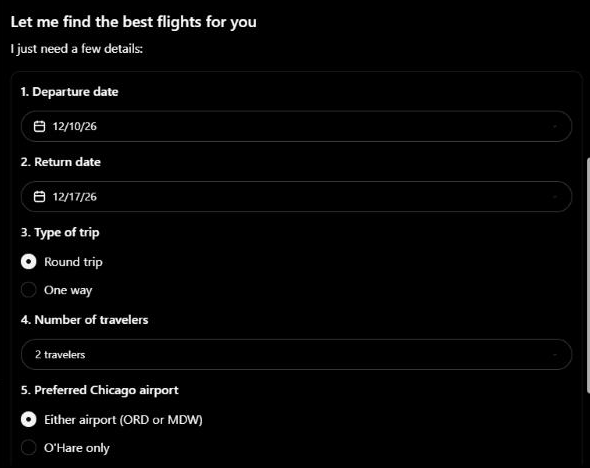
ChatGPT’s reply to “Find me flights from Chicago to Cancun”: no fares, but an intake form asking for the departure and return dates, trip type, number of travelers and preferred airport.
Tracking those prompts measures how the assistant opens a conversation, not how it answers a flight search. Citation rates built on them say little about the flight page.
In Google AI Mode, short route queries such as “flights from London to Miami” remain a sensible seed panel. Users reach AI Mode through search, and its answer does not stop to ask for dates.
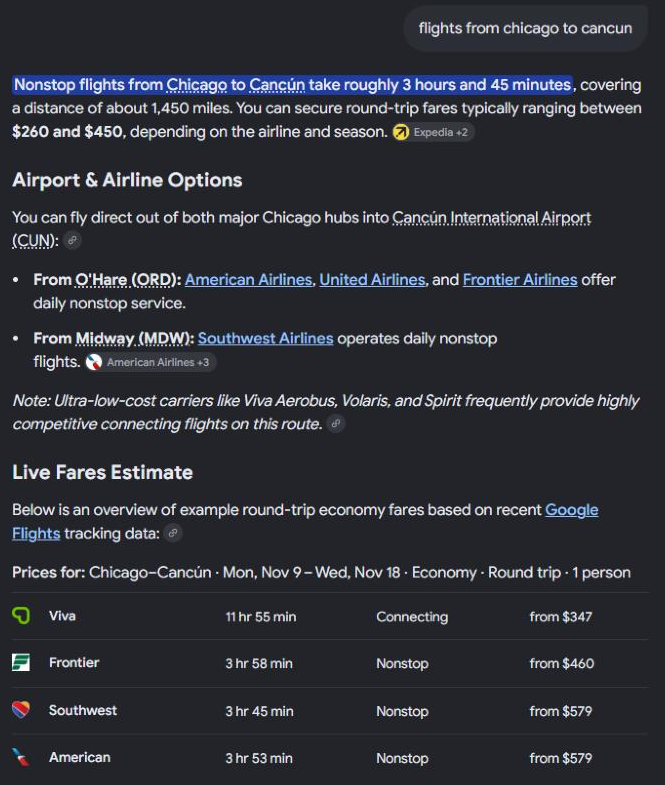
Google AI Mode’s reply to the seed query “flights from chicago to cancun”: a full answer with flight time, airlines and round-trip fares, without asking for dates.
That is not the case in ChatGPT, which, according to PROS data, sends more traffic to airline websites than any AI source other than AI Mode. The change below applies to ChatGPT and other conversational assistants.
Add the Trip Details a Traveler Would Give
The fix is to supply the basic details the assistant would otherwise ask for: dates and number of travelers. Then, the assistant answers almost every time, with fares, airlines and sources.
One detail matters most: the trip length. Without it, the assistant still asks for a return date, even when the departure is given. “1 week trip” already implies a round trip, so adding the words “round trip” changes little. A one-way request works with a departure alone.
The recommended core prompt permutation:
Find me flights from {origin} to {destination}, in 1 month from now, 1 week trip, 1 adultChoose the Details From How Your Travelers Search
Base the look-ahead, trip length and party size on first-party booking-search data rather than guesses. Booking-engine search events in web analytics usually carry the search date, departure date, return date and passenger count.
For the airline searches we analyzed, the typical search departed about a month ahead, was for one adult and was a round trip, with stays clustered around three to seven nights. “In 1 month from now” and “1 week trip” are the closest round figures, and round figures read like something a person would type.
Keep the Date Relative and the Wording Generic
- Relative dates scale. “In 1 month from now” resolves to a concrete date on every run and keeps the same look-ahead without maintenance. Log the collection date: the searched dates move with each run, so seasonality and look-ahead travel together.
- No airline-specific words. The template carries no brand, fare type or airline feature, so the same prompt works for every route and every carrier, and results can be compared across a portfolio.
- Validate before scaling. Before rolling the template into a new market or language, run a sample of routes and confirm the Full Answer Rate holds.
Test Look-Ahead and Qualifiers as Controlled Layers
Use a smaller secondary panel built on the complete prompt, changing one factor at a time:
- Look-ahead: 1 week, 1 month and 2 months from now, with the same wording.
- Trip type: a one-way version, for example “one way, in 1 month from now, 1 adult.”
- Qualifiers: nonstop, cabin, budget or a travel month, one at a time.
The question for each layer is whether the airline keeps its citation when the request changes what the assistant must retrieve.
Use the assistant’s own searches to choose qualifiers. Platforms rewrite a prompt into one or more searches (fan-outs). For complete flight prompts, ChatGPT’s searches consistently include explicit departure and return dates and rarely name an airline. Add a qualifier to the panel only when its theme recurs across routes and samples.
Nuances of AI Search Tracking
AI-search tracking has more moving parts than rank tracking. A credible report documents how, where and under what conditions each response was collected.
Frontend and API Results Are Different Measurement Environments
A consumer interface and an API may use different models, search tools, system instructions, context, citation formats, or release schedules. An API offers a controlled collection path, but it should not automatically be presented as what a traveler saw in the public interface. Frontend capture is closer to the visible experience, but it can be affected by login state, memory, personalization, and interface changes.
Memory, Prior Turns, and Personalization Can Change the Answer
ChatGPT Search may use relevant memories when rewriting a prompt into search queries. Google personalization guidance also explains that account activity, location, language, device type, and recent searches can affect results.
For a controlled benchmark, start fresh sessions and minimize carryover context. Temporary Chat does not access or create memories, although enabled custom instructions may still apply. Keep qualitative audits of logged-in conversational journeys separate from the controlled panel.
One Answer Is a Sample, Not a Ranking
Generative answers are not deterministic. In our repeated runs, rates across a full route panel held steady from one run to the next, while the answer for any single route often flipped between citing the airline and not.
- Read trends at the panel or segment level, not route by route.
- Take repeated samples before drawing conclusions about an individual route.
- Compare periods using the same prompt set and collection settings.
- Keep a change log for page releases, schedule changes, model updates and tracking-method changes.
Segment the Portfolio Before Interpreting the Trend
An airline-wide citation rate can hide where action is needed. Segment the results using the same route and content architecture that governs the flight pages.
- Prompt variant and look-ahead: report each canonical prompt and each look-ahead separately; they cite different sources.
- Market and language: country, language and point of sale change the response and its sources.
- Platform and surface: report AI Overviews, AI Mode and ChatGPT separately.
- Page template: City-to-City, Flights From City, Flights to City and other templates support different route needs.
- Route priority: separate strategic routes, hubs, new service and high-demand routes from the broader portfolio.
Choose a Tool for the Measurement Job
AI-search tracking is evolving quickly, and no platform is an independent source of truth. Options include:
- Advanced Web Ranking: tracks Google AI Overviews, AI Mode, ChatGPT Search and Perplexity with controlled prompt sets, competitor comparisons, landing-page monitoring and exports.
- Semrush: combines custom prompt tracking with broader AI-visibility research across Google AI Overviews, AI Mode, ChatGPT Search and Gemini.
- Profound: runs defined prompts across answer engines and captures responses, citations and competitive performance by topic and market.
- Peec AI: tracks prompt-level brand and source visibility, cited domains, historical responses and query fan-outs.
- Ahrefs Brand Radar: offers a large prompt index for discovering citations, cited pages and competitors, with custom prompts for monitoring.
Test each tool with your complete route prompts before committing. Confirm that it captures the full answer text (to score completeness), the cited URLs, the collection location and, where available, the fan-out searches.
A Practical Airline Reporting Cadence
A useful operating model does not need dozens of metrics. It needs one complete canonical prompt, a stable scorecard, consistent segmentation and enough time to separate sustained movement from model variability.
Monthly Scorecard
- Full Answer Rate, as the gate for everything below.
- Overall, Source and Inline Citation Rates.
- Mention Rate as context.
- Mention-to-Link Rates, with the named-but-not-linked share called out.
- Linked Demand and Demand at Risk, labeled as directional search-demand proxies.
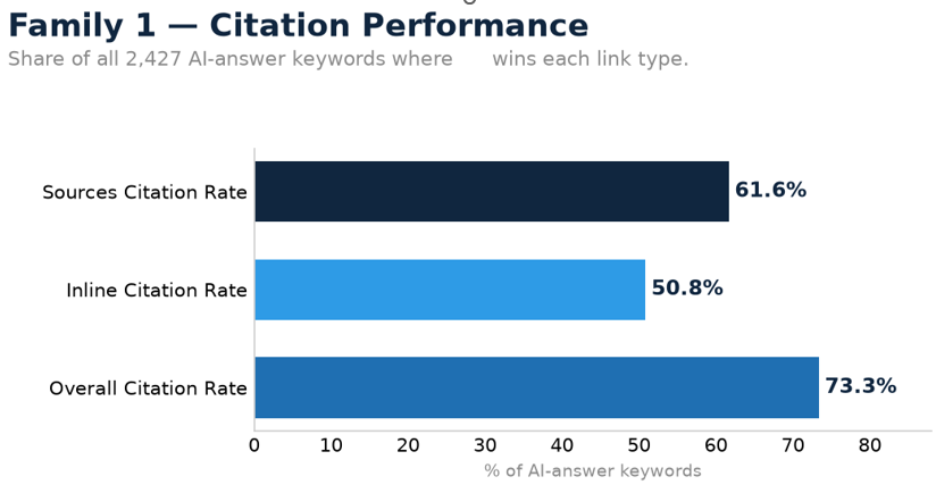
Report the scorecard by the segments above, using the same prompt and collection settings as prior periods.
Quarterly Analysis
- A look-ahead sweep (for example 1 week, 1 month and 2 months) and a one-way variant on the same routes, to see where the airline’s citation holds and where it drops.
- Competitor, OTA, metasearch and Google Flights citation performance on the same route set, and the third-party pages cited instead of the airline.
- Fare coverage on the airline’s route pages for the dates the panel searches, compared with the pages cited instead.
- Routes and segments with the largest sustained citation gaps.
- A manual review of a sample of answers: citations, unlinked mentions and clarification questions.
- Page or feature changes associated with sustained movement against stable comparison groups.
Where analytics data is available, pair citation tracking with referral sessions, engagement and bookings. Google’s Generative AI performance report provides a dedicated view of impressions, pages, countries, devices, and dates for AI Overviews and AI Mode. The report is still rolling out and does not replace prompt-level citation tracking or on-site conversion analysis. The hierarchy stays the same: mentions measure association, citations measure an owned path, and on-site behavior measures what happened after that path was used.
Conclusion
Airlines should keep tracking mentions, but in the right place. Mention Rate is a baseline for brand-and-route association, not a success metric in a category where only a few carriers serve each route.
In conversational assistants, start by making sure the prompt gets a real flight answer. A bare route prompt mostly measures a follow-up question. A complete trip request, with a relative departure, a trip length and a party size taken from how travelers actually search, gets fares and sources almost every time, and it scales across every route and every airline.
Then lead the scorecard with Overall Citation Rate, use Source and Inline Citation Rates to understand placement, and use Mention-to-Link metrics to see when the airline was named but someone else got the path. Report citation separately for each look-ahead.
The strongest program combines one complete canonical prompt, controlled collection conditions, portfolio segmentation and sustained trend analysis. Where citation gaps persist, compare the airline’s route pages with the pages cited instead, starting with fare coverage for the dates the panel searches. That is how AI-search measurement becomes a route-information strategy rather than another visibility report.
Airline AI Search Measurement: Frequently Asked Questions
Yes. Mentions show brand and route association, competitive presence and factual accuracy. Treat them as baseline or diagnostic signals, not proof that the airline earned a link or a visit.
Overall Citation Rate: the share of full answers that include at least one airline-owned link. Read it only after confirming the prompts produce full answers.
Because the assistant usually replies by asking for dates and a return. Adding a departure time frame, a trip length and the number of travelers turns most of those replies into full answers with fares and sources.
One complete, generic template for every city pair, for example “Find me flights from {origin} to {destination}, in 1 month from now, 1 week trip, 1 adult.” Adjust the look-ahead, trip length and party size to your own booking-search data, then keep the template fixed for trend reporting.
A source citation appears in the answer’s supporting source panel. An inline citation is a link inside the answer text. Track both, plus a deduplicated overall rate.
No. Use one canonical complete prompt for trends and a small secondary panel that changes one factor at a time: look-ahead, trip type or a single qualifier such as nonstop.
No. It can help prioritize routes, but it does not measure how often travelers ask AI assistants about them.
Monthly for the scorecard and quarterly for deeper analysis, such as look-ahead sweeps, competitor citations and fare coverage on the route pages.