
This guide serves as a strategic playbook for airline leaders to understand how to integrate PROS Real-Time Dynamic Pricing (RTDP) into their ecosystem, adopt continuous pricing, and capture the significant business benefits of this new approach. It is written primarily for Revenue Management leaders, with implications relevant to Distribution, eCommerce, IT, and Revenue Accounting teams as well.
Introduction: The Shift from Static Fares to Continuous Pricing
For decades, airlines have operated within rigid fare buckets and filed fares – a system shaped by past technological constraints, rather than an optimal revenue strategy.
Today, airline pricing stands at a critical turning point. As the industry advances toward modern airline retailing, the cost of inaction is too high to ignore. Airlines that cling to fixed fare ladders risk losing market share, revenue, and customer loyalty, while more agile competitors leverage real-time dynamic pricing to deliver tailored offers and shift toward class-free retailing.
Modern revenue management now demands real-time precision. Continuous pricing is redefining how airlines convert lookers into bookers, improving the customer experience, and unlocking hidden revenue potential.

Why Continuous Pricing Matters More Than Ever
The business case for continuous dynamic pricing is clear and compelling, as airlines modernize revenue management and pricing in preparation for the Offer and Order retail transformation. Dynamic pricing allows airlines to adjust fares in the moment based on actual demand and market conditions, rather than pre-publishing through endless fare cycles. This flexibility yields several key benefits.

Increase Conversion and Revenue
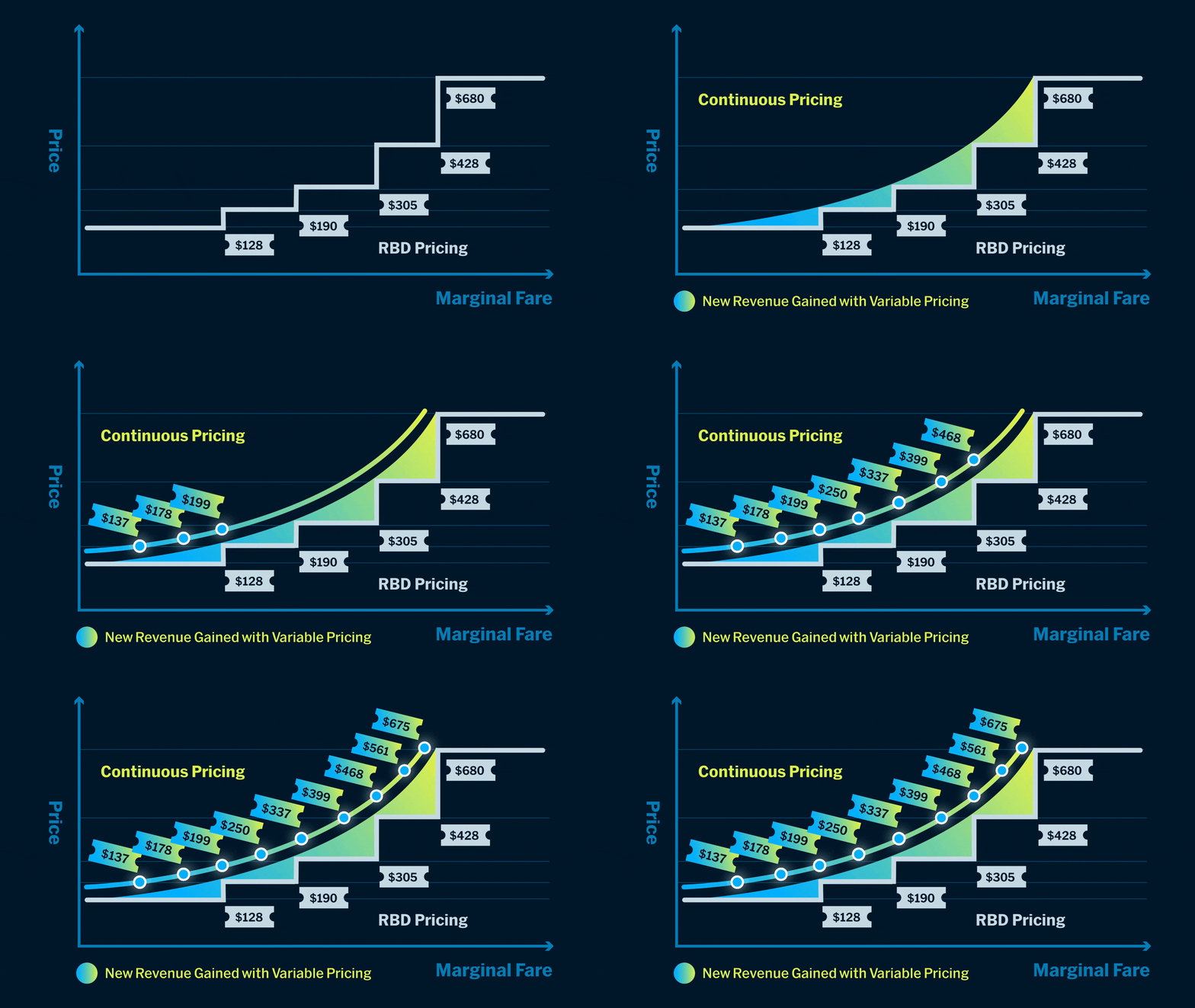
Continuous pricing enables airlines to offer a wider range of price points, so customers are more likely to convert. Traditional filed fares force travelers into fixed price buckets – often either too high, leading to lost sales, or too low, leaving revenue behind. By filling the gaps between static fare levels, airlines can capture incremental revenue that would otherwise be lost.

Respond with More Precision to Market Changes
Dynamic pricing gives airlines the ability to respond instantly and with precision to market volatility. If demand surges for a flight, pricing responds accordingly to maximize yield. If a competitor drops fares or demand softens, prices can adjust downward to stimulate bookings. Traditional filed fares and rigid booking classes simply lack the flexibility required for this level of agility.

Improve Customer Experience with Tailored Offers
With continuous pricing, fare increases are gradual, rather than in large jumps. Customers see fares that more precisely reflect market conditions and better fit their budget. In fact, continuous pricing also results in lower fares being offered that would not exist in a filed fare structure, giving price-sensitive travelers more options and resulting in improved conversion and satisfaction.

Enable Modern Retailing and Dynamic Offer Creation
Continuous pricing is a cornerstone of modern airline retailing. It frees airlines from the constraints of filing every fare with ATPCO and enables the next steps in dynamic offer generation. By adopting continuous pricing now, airlines are better positioned for the Offer and Order transformation, while adopting a value-driven approach to the retail transformation.

Proven Results at Scale
Continuous pricing isn’t just theory – it’s in production today at major airlines, handling massive transaction volumes. It has been deployed at some of the largest airlines globally. One major carrier is leveraging the PROS platform to compute up to 168 million price recommendations per minute without performance trade-offs. This kind of real-world scalability gives airlines the confidence that PROS dynamic pricing is designed for the real-time needs of digital retailing.
Continuous pricing is a win-win for both the top line and the customer. But the advantages for airlines go further: introducing more dynamic and relevant pricing on direct channels shifts sales to more cost-effective platforms and lowers distribution costs for airlines. Additionally, real-time pricing frees analysts to focus on strategic initiatives rather than system overrides or excessive fare filing, potentially improving the bottom line. Early adopters like the Lufthansa Group, which has been using PROS continuous pricing since 2020, are already seeing measurable results. Their progress underscores a simple reality: airlines that delay risk falling behind as the industry accelerates toward modern retailing.
Modernizing Revenue Management & Pricing: The Strategic Roadmap
While continuous pricing is a flip of a switch in PROS Real-Time Dynamic Pricing (RTDP), its successful implementation requires strategic planning, alignment, and execution. It’s best approached as a phased transformation that spans sales and distribution, booking, ticketing and servicing, and revenue accounting processes.
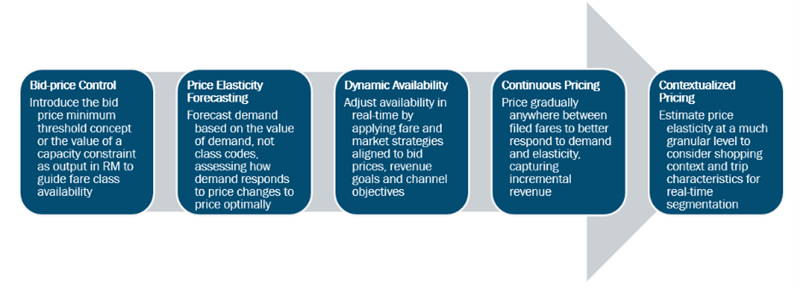
Airlines that have succeeded treat the adoption of dynamic pricing as a distinct stage in their offer optimization maturity journey towards class-free retailing, not as a one-off project. Below, we share the PROS recommended roadmap for modernizing RM and pricing, recognizing that each airline’s path depends on its unique commercial strategy and operational readiness.
These milestones reflect PROS belief that to successfully implement dynamic pricing strategies, airlines must first internalize the economic principle of price elasticity as a foundational element of their Revenue Management (RM) process. By adopting an economist’s mindset, RM teams can move beyond restrictive legacy class-based frameworks and begin optimizing for revenue maximization. It is a strategic shift that enables airlines to build the necessary capabilities for class-free Offer- and Order-based retailing today, positioning them to lead the market as the industry continues to evolve.
PROS Strategic roadmap to class-free RM and pricing: right-to-fly optimization
The RTDP Algorithm: Designed for Dynamic Pricing
PROS Real-Time Dynamic Pricing (RTDP) allows airlines to embed the dynamic pricing calculation as an integral part of the revenue optimization process, not as a short-term fix to existing class-based pricing. As you will see later in this guide, this proves as the safe and optimal, but also future-proof approach to price optimization.
RTDP leverages advanced AI to optimize both availability and pricing at the moment of shopping. It evaluates price elasticity and other demand signals to recommend the optimal price point for every offer. This principle applies regardless of whether the airline’s pricing approach uses booking classes or not. In essence, it enables airlines to always produce outputs that are optimal from a revenue maximization perspective, allowing pricing sophistication to seamlessly evolve from availability to continuous pricing and beyond.
That’s why a key first step in an airline’s dynamic pricing journey is to evolve to an elasticity-based RM approach executed through dynamic availability. Many airlines use this advanced logic to interpret demand signals more accurately and manage booking classes in real time based on bid price control, rather than relying solely on static class closure rules.
This initial stage of maturity builds confidence in automation and encourages a shift in mindset – from managing class codes to focusing on price optimization, helping RM teams become comfortable with dynamic pricing. By dynamically controlling availability, analysts can take a more strategic approach to fare management: deploying competitive pricing to capture market share where needed, and targeting high-yield demand in markets where the airline holds a competitive advantage, while successfully managing buy-down.
Today, PROS market-leading1 technology is trusted by airlines of all sizes to execute revenue management and pricing strategies with greater precision, even while still operating with filed fares and booking classes.
Continuous pricing then extends this capability by enabling price points between the traditional fare classes. Instead of selling only the exact filed fares, the airline can adjust the price in finer increments, allowing for incremental revenue uplift around “3% revenue lift for first movers and about 1% when all airlines in the market adopt it”, according to industry research2.
PROS RTDP supports both approaches: it works within the traditional RBD structure by dynamically adjusting which fare class is offered, while allowing the transition to class-free continuous pricing where any price point on the spectrum can be quoted.
Continuous pricing allows infinite price points
From Optimal Price to Issued Ticket: How the Continuous Pricing Model Works
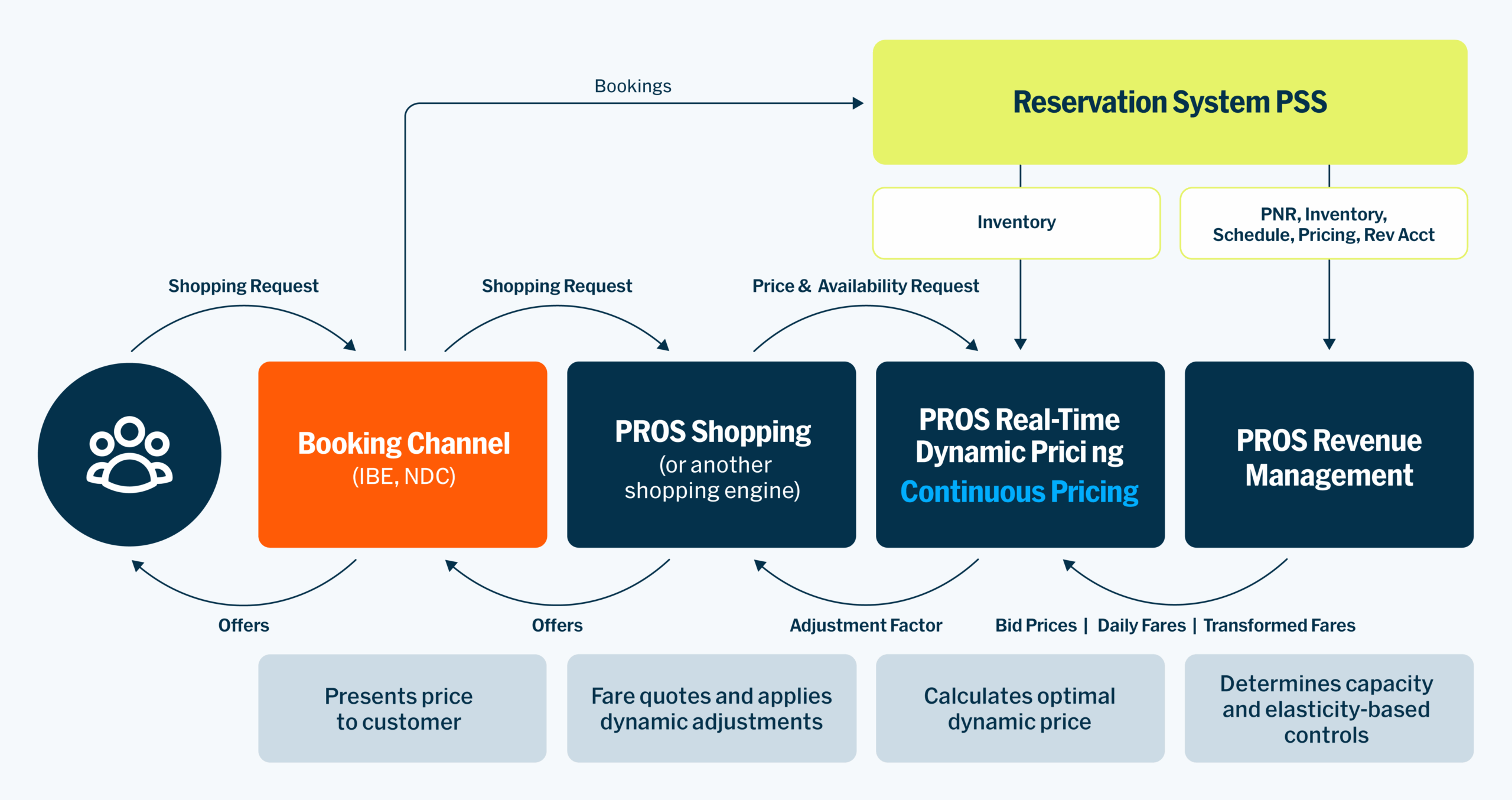
At the core of PROS continuous pricing is a real-time algorithm that calculates the optimal fare using inputs supplied by the airline’s revenue management system. PROS RM provides the foundational science – price elasticity estimates and bid prices that reflect the value of seat capacity, and fare data such as daily and transformed fares.
RTDP draws on these RM inputs to compute a continuous price adjustment: a percentage modification to the available fare that ensures every offer balances conversion and yield by reflecting both current demand signals and the forward-looking value of seat inventory.
While RTDP operates within today’s class-based workflows, its underlying algorithm is not dependent on fare classes. It is designed to support both current RBD-based environments and future models where class codes are no longer required, while being embedded right where it should – at the heart of the selling decision. This makes RTDP a future-ready solution that supports airlines as they transition to offer- and order-based, class-free retailing at their own pace.
Now, let’s review how a dynamically generated price actually makes it into a booked ticket in a class-based setup. The process can be integrated into the airline’s existing shopping and reservation flow today by adapting downstream systems and workflows to automatically consume the adjustment factors.
Shopping and Distribution
First, a customer initiates a flight search on an airline’s direct channel – this can be the airline’s internet booking engine (IBE) or its NDC platform. The carrier’s shopping system (for example, PROS Shopping or another shopping engine) receives the search request. The shopping engine then calls PROS RTDP behind the scenes to retrieve real-time price recommendations using industry-standard availability request messages (PAOREQ, IAVYRQ). As part of that request, the shopping engine passes along the passenger and full journey details provided by the customer for both outbound and inbound flights.
RTDP evaluates the request against the airline’s business rules, returning its recommended price adjustment in milliseconds. This value, represented as a four-digit decimal indicating a percentage discount, is included in the DIS line of the response for each compartment and availability request (TVL).
Then, the shopping engine applies that adjustment to price the itinerary in the lowest available class, using the chosen RBD and the applicable fare basis code (FBC), and also adding taxes/fees and packaging ancillaries as needed. This results in a set of valid offers that are continuously priced and available for the booking engine or NDC platform to display.
A key requirement for successful deployment is to ensure that the booking platform (IBE or NDC) can store the adjustment factors, so that the modified fares can be processed and reconciled accurately downstream. This capability is widely supported today across modern booking engines.
Booking and Ticketing
Once the traveler selects an offer to book, the booking platform (IBE or NDC) receives the quoted fare, including the price breakdown, with the adjustment from the shopping engine to create the Passenger Name Record (PNR) in the reservation system. To issue the ticket, the system must record that the fare was dynamically generated against a valid booking class and FBC, so it can be validated and reconciled downstream. For airlines using the Amadeus reservation system, this means that a Transitional Stored Ticket (TST) with the modified dynamic price must be created during booking, preferably triggered automatically vs. manually. For airlines using the Sabre reservation system, the process involves an additional fare quote before the ticket is issued. For other Passenger Service Systems (PSS), these specific adaptations may vary, but in all cases, the integration must ensure that the system recognizes when an adjusted fare differs from the originally filed ATPCO price. Some PSS providers already support these workflows, making it easier for airlines to incorporate continuous pricing into their retail technology ecosystem without major modifications.
Throughout this process, the integration of RTDP is invisible to the customer. The traveler simply sees a price and books the ticket, just as they always have. The dynamic adjustment of the shopping and booking flows occurs entirely in the background, preserving a seamless experience while enabling real-time price optimization.
Shopping flow with PROS continuous pricing
Scalability and Control
PROS RTDP is built for the scale and reliability of modern airline retailing demands, handling hundreds of millions of pricing calculations per minute in a cloud environment. Airlines retain full commercial control through configurable business rules and guardrails. These parameters can be configured in the system to define which markets, channels, or fare products continuous pricing applies to. It also allows to set guardrails, like maximum adjustment from filed fares. This means revenue managers can confidently deploy dynamic pricing, knowing that the system will behave within defined bounds, aligned with the airline’s commercial strategy.
In summary, PROS RTDP acts as an intelligent, real-time price optimization brain that plugs into your existing ecosystem. It uses advanced AI to calculate optimal pricing that feeds into shopping and booking flows. The result is continuous pricing in action: the airline can essentially offer infinite price points without the burden of endless fare filing, yet tickets can still be issued and accounted for in the current legacy systems with no interruption.
Key Considerations for Adopting Continuous Pricing
Now that we’ve outlined the strategic roadmap and explained the fundamentals of RTDP and continuous pricing, let’s explore how airlines can integrate this capability, emphasizing a modular approach that minimizes risk and operational disruption.
Establish the Foundation – Data & Forecast Readiness
For optimal outcomes, Pricing must operate in perfect harmony with Revenue Management. Before activating RTDP, airlines should confirm that their core data and RM system are prepared to support dynamic pricing. As explained earlier, accurate fares and bid prices are critical prerequisites for dynamic pricing. Validate that your forecasts and pricing optimizers produce reliable estimates of unconstrained demand and price elasticity. Confirm that your fare ladders are well-structured, and that transformed or net fares are up-to-date for each booking class. These elements form the foundation on which RTDP calculates real-time price adjustments.
Finally, ensure that your system provides real-time access to inventory data, since up-to-date seat availability is critical for precise pricing decisions. Where needed, calibrate or upgrade systems and processes before layering in dynamic pricing capabilities.
Integrate Continuous Pricing into the Shopping Flow
With a solid foundation in place, you can move to step two – deploy continuous pricing on live channels. A best practice is to start with a pilot direct channel – a specific market or an NDC partner where you have the most control and a modern API-based integration.
In this stage, PROS RTDP is integrated with the shopping engine for this channel. If you are using PROS Shopping solution, no additional integration is required as the two solutions are pre-integrated and operating at scale with multiple carriers. PROS shopping engine simply calls RTDP for each search request and returns continuous prices in the offer results. If you use a third-party shopping engine, RTDP’s output – the price adjustment factor – must be consumed by the shopping engine to adjust the fare calculation. PROS customers have implemented continuous pricing using different engines for different channels, often selecting PROS for traffic intensive channels to optimize shopping costs. Once your pilot is live, validate the end-to-end shopping flow works as expected and monitor key metrics – look-to-book ratios, average selling fares, revenue uplift vs. control group, and more.
Expand to More Direct Channels and Distribution Partners
Once continuous pricing performs reliably in the pilot stage, the next step is to broaden the scope. Many airlines choose to extend dynamic pricing to their entire NDC channel early on, both to drive higher direct sales and leverage IATA NDC’s (New Distribution Capability) native support for richer offers and continuous pricing, empowering the airline with offer control. Ensure the shopping engine powering your NDC platform passes shopping requests to RTDP and consumes the adjusted prices returned. In parallel, evaluate your direct strategy for OTAs and metasearch engines. You can still benefit by implementing continuous pricing for certain high-value partners like Expedia, Skyscanner, and Trip.com.
As a rule of thumb, focus first on channels where you control offer creation: website, NDC API, major OTA, and MSE partners via API. This phased expansion ensures you capture incremental revenue opportunities within the technological constraints of each channel.

Systems Upgrades and Integration Considerations
During the integration process, it’s important to identify any necessary upgrades or adjustments in your tech stack. PROS RTDP is designed to co-exist with legacy systems, but certain touchpoints in the shopping and booking flow may require enhancement. For instance, ensure your booking platforms (IBE, NDC) or web services layer can handle new input/output fields, such as receiving adjusted prices or new fare identifiers. Don’t neglect back-office processes: revenue accounting, auditing and reporting, rebooking, and customer servicing workflows will need restructuring to recognize dynamically priced tickets (e.g., handling non-standard fare amounts or ensuring refunds/reissues use the correct values). Engaging teams like finance, accounting, and taxation early in the project can surface regulatory or compliance considerations, which vary by market. The good news is that none of these changes are insurmountable. As multiple airlines have discovered, deploying continuous pricing can be done in legacy setups with the right planning. You just need to make sure that all the cogs in the machine – systems, people, and processes – are prepared for the new pricing approach.
Cross-Functional Training and Change Management
Continuous pricing is a cross-functional evolution that impacts pricing, distribution, IT, finance, and commercial strategy. Airlines that succeed treat adoption as a business transformation supported by technology, not the other way around.
As Ramesh Anantharaman, Divisional SVP, Revenue Management & Business Effectiveness at flydubai, wisely observes, the biggest challenge is often “changing people and the mindset” rather than the technology itself – so invest in stakeholder education and change management early. A successful continuous pricing integration is as much about people as it is about technology. It’s critical to train and align your teams with the new processes. Revenue management and pricing analysts should be trained on how the dynamic pricing engine works with the RM system – so they trust the recommendations and learn to tweak strategies via system inputs and controls rather than manual overrides. eCommerce and distribution teams need to understand the new pricing flows to handle any customer inquiries or edge cases. Sales, distribution, and agency partners should be informed of potential fare differences to ensure consistent communication across channels. As PROS dynamic pricing experts emphasize, strong cross-functional alignment is the make-or-break factor for dynamic pricing success. Some airlines form a cross-department “war room” during rollout to ensure questions are answered quickly, and everyone stays on the same page. Communicate the vision and benefits widely internally – when all stakeholders see that continuous pricing drives revenue and improves customer conversion, resistance will weaken. And don’t forget to celebrate quick wins: once initial results show uplift, share that success to build momentum and confidence in the new system.
Monitor, Iterate, and Scale Up
After initial deployment, adopt a test-and-learn approach to refine your continuous pricing strategy. Conduct A/B tests and monitor KPIs to validate revenue lift and conversion improvements. These experiments also help fine-tune elasticity inputs, control parameters, and rule applicability, ensuring the pricing engine behaves as intended. Once the results meet and surpass expectations, scale continuous pricing to additional routes, markets, and channels. Throughout the adoption, PROS provides partnership, support, and guidance, helping airlines analyze results, optimize configuration, and strengthen the alignment between RM strategy and pricing execution.
By following this phased approach, airlines can adopt PROS RTDP in a structured way that delivers value at each milestone. The overarching theme is progressive transformation – you don’t need to rip out and replace everything overnight. Instead, you layer in dynamic pricing, proving the benefits as you go. This approach not only mitigates risk but also accelerates time-to-value, allowing an airline to capture revenue gains while planning broader rollout.
Understanding Data and System Integrations
Integrating a continuous pricing engine like PROS RTDP into an airline’s ecosystem naturally raises questions about data requirements and system compatibility. Below, we outline the key considerations to ensure smooth technical integration that complements your existing platforms.

Connecting to the Pricing and Booking Engines and PSS
PROS RTDP is designed to slot into your pricing workflow without replacing your core reservation system or PSS. In practice, RTDP is invoked during the shopping request workflow. If you use PROS shopping module, the integration is native. If you use another shopping engine (from Amadeus, Sabre, another vendor, or a custom solution), PROS exposes APIs that those engines can call. The output from RTDP is an adjustment value that the shopping engine uses to modify the base fare and calculate the final price displayed to the customer. The booking engine must then consume and store the modified fare before ticket issuance. Crucially, this “overlay” approach allows continuous pricing to coexist with legacy systems: the PSS still issues the ticket against a valid fare class, keeping continuity with downstream processes such as e-ticketing and revenue accounting, even though the final price differs from the filed fare.
Real-Time Data Inputs
PROS RTDP draws on a variety of data sources to compute prices. Key inputs for continuous pricing include current inventory seat index (remaining seats in each class and cabin), bid prices, elasticity estimates, and fare data. Many of these come from the revenue management system – PROS RM or another RM tool provides the bid price and price elasticity curve for each flight. RTDP ingests fare data (daily and transformed fares) to know the “baseline” structure. Even while operating class-free, it still references the fare ladder in the output for compatibility with downstream systems. Inventory changes (bookings, cancellations) are reflected via the airline’s inventory system. RTDP retrieves real-time availability either via API calls or through near real-time push updates, depending on the airline’s technical capabilities. Most integrations rely on API-based synchronization, with updates occurring daily, on demand, or in real time depending on the data type. PROS has established integrations with all major PSS platforms, ensuring reliable and consistent data flows that keep RTDP’s recommendations accurate and up to date.
Shopping Performance and Scaling
To support increasing shopping volumes and dynamicity, PROS employs a scalable cloud infrastructure capable of handling extremely high transaction throughputs. Real-world operations at major carriers have demonstrated that dynamic availability, dynamic pricing, and shopping across high look-to-book shopping channels, like NDC-connected online travel agencies or metasearch engines, can be handled cost-efficiently without degradation in response times or look-to-book outcomes. During implementation, the PROS team conducts load and performance testing to ensure that both your systems and the PROS cloud environment can handle peak search volumes. This guarantees optimal response times and system stability even under heavy demand, ensuring a seamless shopping experience for customers.
Business Rules and Governance
Integrating dynamic pricing also means integrating new business logic into your pricing governance. PROS RTDP comes with a user interface that allows analysts to configure pricing rules, set adjustment caps, and monitor pricing results. Ensure your revenue management and pricing teams are equipped to manage this functionality, working closely with IT for any changes that affect system integration or data flows. PROS provides ongoing analytical support post-implementation to help carriers interpret results, fine-tune parameters, and optimize the setup. The goal is to ensure the airline maximizes RTDP’s value and that the dynamic pricing engine operates in full alignment with your airline’s broader commercial and revenue strategy.
Coexistence with Legacy Processes
A major advantage of PROS’s approach to integration is that it does not force an overnight cut-over or big bang system replacement. You can run dynamic pricing along existing ATPCO-based fare structures, while reducing the need for constant fare filing updates. During the transition, you can preserve redundancy and, if necessary, always revert to filed fares in any channel by simply disabling RTDP’s continuous pricing output for that channel via a configuration change. PROS integration philosophy is to meet airlines where they are in their retail tech stack maturity. Whether you are on an in-house PSS or a third-party digital platform, RTDP can be deployed around it to deliver real-time, dynamic prices. This modular strategy means you capture benefits now without waiting for a full tech transformation. In essence, PROS RTDP and related offer optimization tools act as a layer of innovation outside legacy systems, translating modern pricing tactics into the old constructs until those old systems can be phased out in the class-free future.
By addressing these data and integration considerations, airlines ensure that the adoption of continuous pricing is technically smooth and robust. The takeaway is that you do not need to overhaul your entire ecosystem to deploy continuous pricing – RTDP integrates safely with and augments what you have today.
Embracing Continuous Pricing with PROS: Your Path to Revenue Growth
The transition from static fares to continuous pricing is one of the most significant transformations in airline commercial strategy in decades. We are moving toward a future of fully adaptive, real-time, class-free pricing that benefits both airlines and passengers. Early adopters – from the Lufthansa Group in Europe to innovators like Air Canada in North America – are seeing tangible rewards in revenue uplift, agility, and customer satisfaction. Their progress underscores a simple reality: airlines that hesitate risk falling behind as the gap widens between modern retailing and legacy practices.
Stefan Kreuzpaintner, SVP Commercial Customer Offer
Richard Cleaz-Savoyen, Managing Director, Revenue Optimization
The good news is that adopting continuous pricing is an achievable goal today, not a distant vision. With PROS as your partner, the process can be approached with step-by-step modular integration that works with your existing ecosystem, but prepares you for a class-free future. PROS brings deep expertise – our team has over two decades of experience in airline dynamic pricing and has supported over 30 airlines in successfully implementing dynamic pricing algorithms for passenger, group, and ancillary sales. We understand both the science and change management required, and we work alongside your team to ensure success at every phase.
In an industry notorious for its razor-thin margins, continuous pricing is not just a tech upgrade – it is a strategic imperative for sustained revenue performance. It equips your airline to maximize revenue on every seat, every day, and is a steppingstone toward the future of offer optimization. Airlines that master continuous pricing now will be positioned to lead in the era of dynamic offers and modern airline retailing that is on the horizon.
The question is no longer if dynamic pricing should be implemented, but how quickly your organization can act to capture the benefits ahead.
Now is the time to act.
We encourage you to take the next step: book a demo with PROS to see continuous pricing in action. Let’s transform your revenue strategy together.
Sources:
[1] T2RL The Current State of Dynamic Pricing 2024 & T2RL The Market for Airline Revenue Management Systems 2024
[2] Science studies across MIT Air Transportation Systems, PODS and others.
Frequently Asked Questions
Continuous pricing allows airlines to adjust fares in real-time based on demand and market conditions, moving beyond rigid fare buckets to offer more tailored and competitive pricing.
It increases revenue by filling gaps between static fare levels, improves customer satisfaction with tailored offers, and enables airlines to respond instantly to market changes.
PROS RTDP is an AI-driven solution that integrates with airline systems to calculate optimal prices in real-time, supporting both class-based and class-free pricing models.
By offering gradual fare increases and more price points, continuous pricing provides options that better fit travelers’ budgets, enhancing satisfaction and conversion rates.
Airlines need to ensure data readiness, system integration, and cross-functional alignment. Change management and training are critical for successful implementation.
Yes, PROS RTDP integrates seamlessly with existing systems, allowing airlines to adopt dynamic pricing without overhauling their entire ecosystem.
Early adopters like Lufthansa and Air Canada report revenue uplifts of 1-3%, improved agility, and enhanced customer satisfaction through PROS RTDP.