
The industry’s retail transformation is moving from vision to executive priority. Leading airlines are investing in Offer and Order transformation programs, prioritizing new retailing capabilities designed to improve both commercial performance and customer experience.
For many airline leaders who are building their transformation roadmaps, the biggest challenge remains creating value along the way, before transformation is complete. The most successful transformation programs are not waiting for a future-state architecture to arrive but identifying where value can be created today while building toward tomorrow.
And increasingly, that starts with the airline product and offer.
Modern Airline Retailing Is a Commercial Transformation
What got the industry to where it is now won’t take it where it needs to go next. Typically, transformation conversations focus on technology platforms, standards, and architecture. Technology matters, but only when it enables the airline’s commercial strategy. Too often, retail transformation is framed as a technology modernization initiative. The assumption is that replacing legacy systems with modern platforms will automatically create a modern retailer. It won’t.
Commercial strategy must dictate the capabilities an airline needs and technology should support those capabilities, not define them. A platform may be built on modern architecture, support end-to-end workflows, and operate in the latest technology stack. That does not necessarily mean it enables the commercial agility airlines need to compete. The real question is whether it gives commercial teams greater control over products, offers, pricing, distribution, and customer experiences. This is the difference between an IT stack designed for better offers and outcomes, and one designed to support operations.
The real transformation is commercial: technology is the enabler, commercial agility is the objective.
Most Airlines Will Operate in a Hybrid Environment for Years
One reality has become increasingly clear across the industry is that the transition to Offers and Orders will not happen overnight. Legacy channels, processes, and distribution relationships, will remain important for years to come.
That means most airlines will operate in hybrid environments as they modernize. For airline leaders, this changes the conversation.
The organizations making the most progress are not pursuing a big-bang transformation. They are introducing new capabilities incrementally, creating measurable value at each stage, and building confidence across the business as they go.
Start with Product Management
Many airlines view Offer Management as the starting point for retail transformation. But in reality, Offer Management depends on something fundamental: Product Management. Before you can optimize an offer, you need a clear understanding of what you can sell.
Historically, product definitions, ancillary services, inventory, and pricing constructs have been fragmented across multiple systems. That approach limits agility and makes it difficult to introduce new products, create new bundles, or adapt quickly to changing market conditions.
Modern retailing requires a different model.
- A modern product catalog creates a centralized view of products, attributes, rules, eligibility, and relationships. It provides the foundation for managing flights, ancillaries, and third-party content as commercial products rather than isolated system records.
- A unified stock keeper moves inventory beyond operational tracking. It helps ground every dynamic offer in accurate, real-time availability across flights, ancillaries, and third-party products, ensuring every offer is accurate, available, and aligned to current capacity conditions.
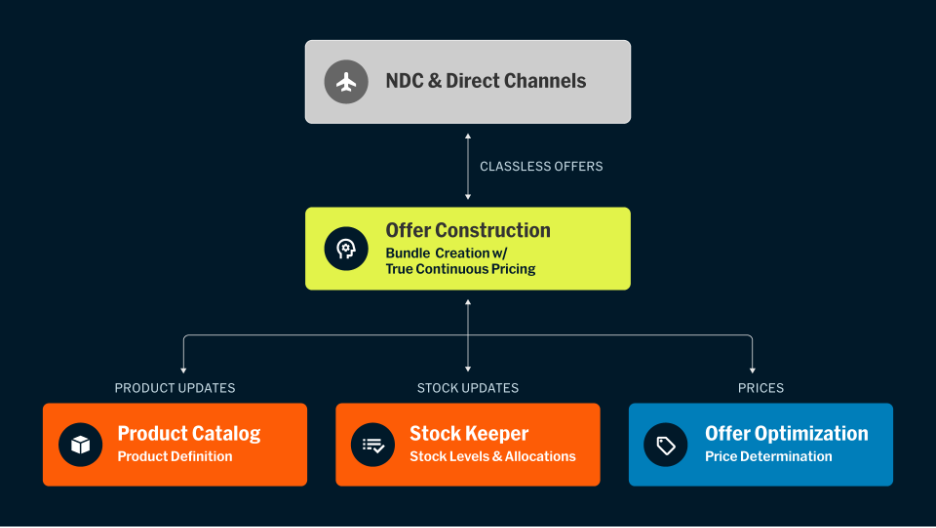
PROS Product Management Ecosystem
The result is greater commercial flexibility. Airline teams can launch new products faster. Bundles can be combined more easily. Third-party content can be incorporated more effectively. Most importantly, this creates the foundation required to build more relevant offers.
Offer Management Is Where Commercial Value Is Created
Once that foundation is in place, Offer Management becomes the revenue engine that brings commercial decisions together. This is where airlines determine which products should be offered, how products should be bundled, what prices should be presented, which channels should receive those offers and how those offers can be better aligned to demand and market conditions.
This represents a significant shift from traditional siloed commercial models. Instead of pricing, merchandising, distribution, and ancillary strategies operating independently, Offer Management creates a central decision layer that aligns those functions around revenue performance.
More importantly, they create the conditions for continuous improvement in pricing, bundling, and retail execution.
Focus on Value, Not the End State
One of the biggest mistakes airlines can make is assuming they need to reach the final Offer and Order vision before meaningful value can be realized. In fact, it’s exactly the opposite.
Many of the capabilities associated with modern retailing can generate measurable commercial benefits long before a complete transformation is finished. Continuous pricing and offer optimization, modern merchandising and richer product content. Each capability creates value independently while also moving the organization closer to its long-term retailing goals. If you’re leading a transformation program, that matters.
The airlines seeing the greatest success are not waiting for the industry to define a perfect end state. They are building capabilities today that improve commercial performance while preserving flexibility for tomorrow.
The Destination Is Commercial Agility
The ultimate goal of Offer and Order transformation is not a new architecture. It is commercial agility. Airlines operate in an environment defined by shifting demand patterns, evolving customer expectations, competitive pressure, and constant market disruption. The ability to respond quickly has become a competitive advantage.
Together, they provide the foundation for modern airline retailing and create the flexibility needed to adapt as the industry continues to evolve.
If you’re beginning the transition to Offers and Orders, the most important decision is where you choose to start. For many airlines, the answer is becoming increasingly clear: start with your products, focus on the offer, and create value throughout the journey.
PROS recently joined IATA’s Offers & Orders Strategic Partners Webinar Series to explore how Product Management, Offer Management, AI, continuous pricing, and modular architecture work together to help airlines modernize incrementally while creating commercial value at every stage of the journey.
Explore the IATA DiscussionFrequently Asked Questions
Airlines can create significant commercial value long before a full Offer & Order transformation is complete. Capabilities such as Product Management, Offer Management, dynamic pricing, and modern merchandising can improve revenue performance, increase agility, and enhance customer experiences while broader transformation programs continue. The most successful airlines are creating value incrementally rather than waiting for a future-state architecture to be fully implemented.
Before an airline can create and optimize offers, it needs a clear understanding of what it can sell. Product Management provides a centralized view of products, ancillaries, inventory, attributes, and business rules. This foundation enables airlines to launch products faster, create more effective bundles, and respond more quickly to changing market conditions.
Product Management focuses on defining and managing the products available for sale, including flights, ancillaries, and third-party content. Offer Management determines how those products are combined, priced, and presented to customers. Together, they allow airlines to control both what they sell and how they sell it, creating more relevant offers and stronger revenue outcomes.
Offer Management brings pricing, merchandising, distribution, and revenue decisions together into a single commercial decision layer. Rather than operating in separate silos, these functions work together to create offers that reflect demand, market conditions, customer needs, and revenue objectives. The result is greater revenue optimization and improved retail execution.
No. Most airlines will operate in hybrid environments for years as they modernize. Modern Product Management and Offer Management capabilities can coexist alongside existing systems, allowing airlines to improve commercial performance while reducing the risk associated with large-scale technology replacement programs.
A modern product catalog provides a centralized source of truth for products, attributes, eligibility rules, and relationships. It allows airlines to manage flights, ancillaries, and third-party services as commercial products rather than disconnected system records. This improves agility, simplifies merchandising, and enables faster offer creation across channels.
Airlines can improve commercial agility, accelerate time-to-market for new products, increase ancillary revenue opportunities, create more relevant offers, and strengthen customer experiences. These capabilities also provide measurable business value that can help fund future phases of retail transformation.
The goal is not simply to modernize technology architecture. The goal is commercial agility. Airlines need the ability to adapt quickly to changing demand, customer expectations, competitive pressures, and market conditions. Product Management and Offer Management provide the foundation that enables airlines to respond faster, create better offers, and drive stronger revenue performance.