




A “Look” is More Than it Appears: The Evolving Cost of Shopping Requests
For much of the airline industry’s history, shopping was primarily a retrieval problem. In the traditional GDS-driven model, fares and rules were largely pre-filed, availability was checked against defined inventory, and many shopping requests returned the same underlying values. While the distribution ecosystem was complex, the marginal cost of an additional look was relatively predictable.
Today, modern airline retailing is disrupting the status quo by challenging legacy models. Airlines are now claiming ownership of their product, price, and distribution, and shifting from distributing fares to retailing offers. Standards such as IATA’s New Distribution Capability (NDC) enable part of this transition, but the strategic change is broader than any single protocol. Moving beyond a model dominated by commercial airline websites on one side and GDS channels on the other, airlines are increasingly opening their content across a wider direct distribution footprint. The goal? More offer control, more effective and efficient retailing, and, ultimately, higher revenues.
What makes this shift powerful also changes the economics of shopping and distribution: in an offer-based world, airlines are no longer simply returning static filed prices, they’re constructing offers in real time. Prices may be dynamically calculated, bundles assembled, ancillaries evaluated, and conditions validated to produce a sellable offer. Even when caching is applied, the shopping system must determine whether an offer remains valid or if it needs to be recomputed. Put simply, a look is no longer just demand being expressed; it’s a request for the airline to perform work. As direct distribution to non-airline channels and partners grows, the work also scales. If offer construction and computation is not deliberately managed, cost can grow faster than revenue.

Why Look-to-Book Ratios Rise Even When Demand Stays the Same
Rising look-to-book ratios are frequently misinterpreted as inefficiency or low-quality traffic. In reality, this metric reflects structural changes in how modern retailing operates.
In an availability-based world, multiple requests could return the same filed fare. In an offer-based world, similar requests may still require fresh evaluation to ensure pricing accuracy and offer validity in compliance with the airline’s direct distribution strategy. Even if the output appears unchanged to the traveler, additional dynamic pricing computation may have occurred behind the scenes to arrive at a final, bookable outcome optimized from a revenue perspective.
Distribution mechanics amplify this effect. For example, a single traveler search can fan out across metasearch engines like Skyscanner, Kayak, and Google Flights, NDC aggregators, and major OTA partners like Expedia and Booking.com. Results are refreshed to avoid stale pricing, validated before booking, and sometimes re-queried through parallel paths. Additionally, airlines often prefer direct connections with these leading distribution partners, as they play a critical role in expanding the airline’s market reach. While direct distribution reduces intermediary dependency, it often increases computational responsibility. Airlines shift from paying distribution booking fees to managing real-time offer construction at scale. What feels like one interaction to the customer can prompt multiple backend requests, each requiring offer control and pricing precision.
Automation further increases baseline volume. AI-enabled tools increasingly search on behalf of travelers, monitoring prices, evaluating rebooking options, and continuously validating availability. Unlike humans, these systems operate constantly. Shopping becomes continuous rather than episodic.
AI is the next big change to reshape the distribution landscape, and this stage is already on the horizon. Airlines and technology providers are discussing “agent-ready flight shopping,” where AI agents interact directly with travelers and airline retail systems to shape travel experiences. Emerging frameworks such as Model Context Protocol (MCP) will reduce integration friction by making it easier for AI systems to connect to tools and structured workflows, allowing more agents to query airline systems programmatically and at scale, bypassing traditional legacy intermediaries in the face of GDSs, travel agencies and aggregators.

The Deeper Shift: Establishing Retail Control Beyond Legacy Dependency
For decades, airlines relied heavily on GDS and PSS infrastructure, not only to sell tickets, but to define how content was priced and distributed. Retail logic lived inside closed systems designed for inventory management, not modern commerce. In many cases, airlines ceded control over how offers were created, optimized, and delivered because the selling layer was outsourced, constrained by legacy architectures, and restricted by contractual relationships.
Over the past decade, airlines have steadily moved toward claiming control over their direct distribution strategy. NDC was an early catalyst, and the broader Offer and Order transformation now underway reinforces that shift. This shift demands reassessing the technical and commercial constraints imposed by incumbent providers. Modern retailing requires control, precision, and autonomy: the freedom to integrate best-in-class offer optimization, pricing, and retail tools into the airline’s core selling stack, and contractual flexibility that does not penalize innovation or lock airlines into a single path.
Even the best offer optimization, like continuous pricing, creates little value if it can’t connect to the airline’s retail backbone, whether that’s an existing PSS environment, an NDC platform, or a future Order Management System.
Offer-to-Order Completes the Picture
While new KPIs emerge, the look-to-book ratio remains a useful indicator of traffic pressure. It tells airlines how much shopping activity is hitting their systems. However, it does not capture how often airlines are performing the highest value-generating action in modern retailing: creating offers.

Offer-to-order measures how many offers are generated for each confirmed booking. It reveals how much computational effort is required to achieve conversion and produce revenue. Two airlines can experience similar look-to-book ratios while operating very different cost structures. One may recompute offers repeatedly for similar requests. Another may reuse or manage offers intelligently in high-search environments. Surface metrics look similar, but the underlying economics vary greatly.
In this sense, look-to-book explains pressure, offer-to-order explains effort, and a broader look-to-value mindset explains return. Look-to-value shifts the conversation from volume to productivity. Are high-search channels producing proportional revenue relative to the computational cost they impose? Is shopping growth translating into revenue-generating orders or merely increasing workload?
Airlines Must Shift from Traffic Control to Offer Economics
When look-to-book rises, the instinctive response is defensive. Airlines tighten limits, reduce refresh rates, or throttle traffic and constrain certain channels. However, these measures are blunt instruments only justified in rare situations. Used too aggressively, they undermine the very retail flexibility airlines are trying to build through direct distribution. The deeper issue is not how many looks arrive, but what those looks trigger and how they are managed from a performance and outcome perspective.
In an offer-based world, efficiency is defined by managing how often and under what conditions offer computation occurs. Not every shopping request requires a newly generated offer. Many are duplicative or near-duplicative, such as the same itinerary queried repeatedly within short time windows or refreshed across similar travel agency partners. Intelligent reuse, defined offer validity policies, and differentiated handling of high-search channels can preserve offer accuracy while reducing unnecessary effort.
Anticipate Pressure Instead of Reacting to It
Managing look-to-book is as much about timing as it is about volume. Airlines often recognize rising shopping pressure only after infrastructure cost increases, performance degrades, or partner complaints emerge. By that point, responses tend to be reactive, focused on limiting traffic, stabilizing systems under stress, and controlling the distribution bill.
As automation increases volatility, airlines need earlier visibility into changes in shopping intensity. Which markets are accelerating? Which partners are generating disproportionate activity, and which are driving the value? Where is search growth decoupling from conversion?
Anticipation enables strategic adjustment before cost escalates, leading to better predictability. Airlines that scale modern retailing successfully collaborate with their technology partners to leverage mechanisms to monitor shopping behavior as a leading indicator, allowing them to refine offer validity policies, channel handling, and operational parameters before system strain becomes visible.
Aligning Offer Computation with Commercial Value: The PROS Approach
PROS is built for the realities of modern airline retailing where rising shopping volumes and high look-to-book ratios put pressure on both commercial performance and infrastructure costs. As airlines scale direct distribution, capabilities that allow them to retail dynamically while maintaining offer control and performance, without inflating transaction cost, will be critical.
PROS approaches this challenge with a simple philosophy: the tools airlines use to construct, optimize, and distribute offers should function as extensions of the airline’s own retail strategy, not as constraints imposed by intermediary-driven infrastructure. To achieve this airlines must own offer creation to control how demand flows through their offer stack and scale direct distribution profitably, protecting systems and prioritizing high-value interactions.
To enable this, PROS applies a three-layer framework that governs how shopping requests are handled, ensuring scalable performance and cost-efficient offer creation.
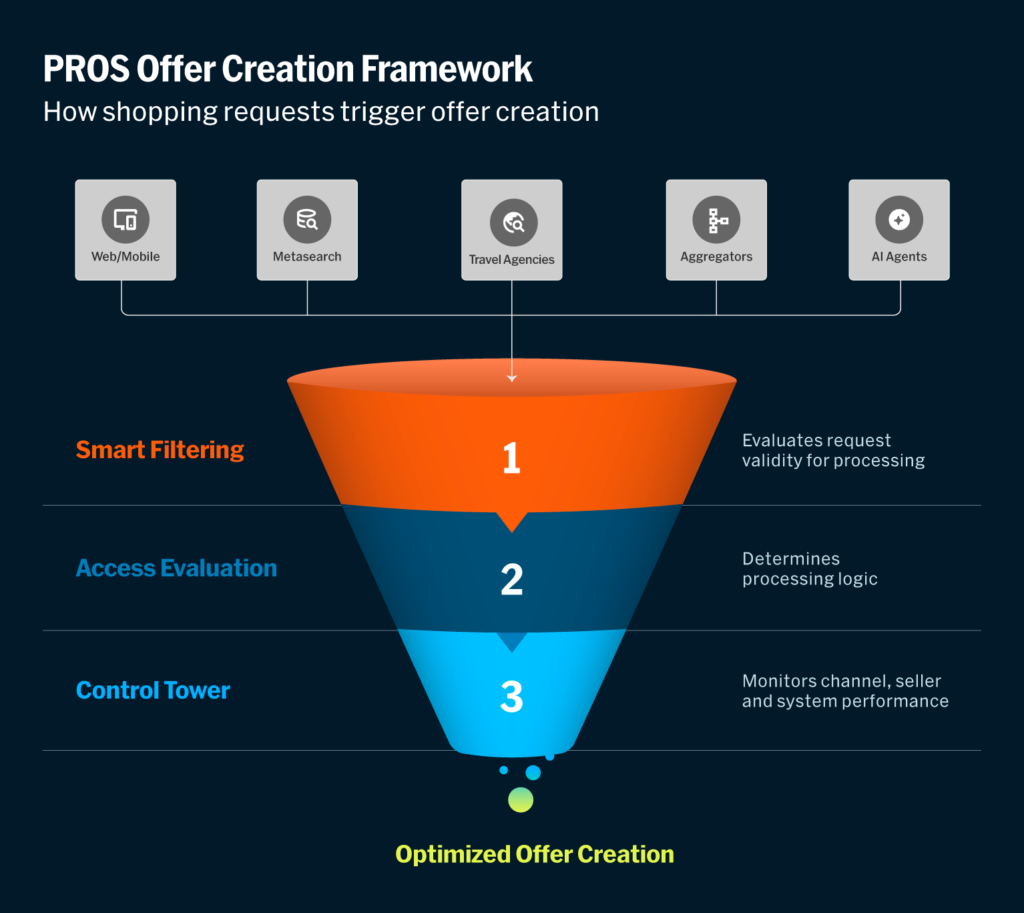
At the point of entry, incoming traffic is first evaluated against a set of basic guardrails designed to protect airline offer systems from unnecessary load. This initial step is intentionally protective in nature, focusing on coarse controls such as request volumes and source validation rather than interpreting the content of the request itself. Any traffic that falls outside these guardrails is rejected early, preventing non-valuable or potentially abusive requests from consuming downstream computation resources.
Requests that pass this initial screening are then handled in a way that aligns with the airline’s commercial priorities and distribution strategy. Rather than treating all demand equally, airlines can differentiate how requests are processed based on channel type, use case, and expected value. This ensures that high-value interactions or priority partners receive the appropriate offer content, while high-volume, lower-conversion environments can be managed more efficiently without computing duplication for repeated or near-identical requests. The result is a more balanced approach to scaling distribution, where performance and cost-to-serve remain aligned with revenue potential.
Finally, through proactive monitoring airlines maintain continuous visibility and control over how shopping demand translates into system load and commercial outcomes. With granular visibility into volumes, usage patterns, and performance across channels and partners, they can continuously refine how requests are handled and where computation is applied. This allows airlines to adapt to changing demand conditions, optimize cost per transaction, and ensure that offer creation remains both scalable and economically sustainable as search volumes grow.
Building on this foundation, PROS combines anticipation through shopping intelligence, control through high‑search offer management, and efficiency through optimized computation to enable airlines to scale offer‑based retailing sustainably across their direct distribution ecosystem.
Master the Economics of Shopping in the Offer Era
Direct distribution is reshaping airline retailing. Legacy models built around static fare distribution are giving way to offer-based retailing, where airlines gain control over how their products are constructed, priced, and delivered. Search volumes will continue to rise as automation scales and agent-ready shopping frameworks mature. Attempting to suppress this growth is neither sustainable nor strategically sound.
The real task is not to reduce shopping, but to manage its economics. Airlines must ensure that offer creation is deliberate, efficient, and aligned with commercial value. Leadership in the offer era will belong to airlines that understand the true cost of computation and convert shopping activity into sustainable profit.

Other Content in This Stream
FAQ
In the past, the cost of a shopping request (or “look”) was predictable because it involved retrieving pre-filed fares. In modern airline retailing, airlines construct offers in real-time, which involves work like dynamic pricing and assembling bundles. This means each look is a request for the airline to perform work, and as direct distribution scales, this computation cost can grow faster than revenue if not managed deliberately.
Rising look-to-book ratios are a structural result of modern airline retailing, not an indicator of low-quality traffic. In an offer-based world, every search—even similar ones—can trigger fresh, real-time offer creation and dynamic pricing calculations. This effect is amplified by distribution partners like metasearch engines and OTAs, which can trigger multiple backend requests from a single customer search to ensure pricing is accurate and up-to-date. As a result, the computational workload increases even when traveler demand remains steady.
For decades, airlines relied on legacy GDS and PSS systems for ticketing, pricing, and distribution, which limited their control over retail strategy. By moving to a modern retail approach, airlines can gain the autonomy and flexibility needed to integrate best-in-class tools, optimize offers with precision, and ultimately claim ownership of their distribution and sales processes without being restricted by outdated technology and contracts.
Look-to-book measures how much shopping activity is hitting an airline’s systems. Offer-to-order, a more modern metric, measures how many offers are generated for each confirmed booking, revealing the computational effort required to achieve a sale. Together, they provide a clearer picture of both system pressure and productivity.
Instead of blocking shopping requests, airlines can shift their focus to managing when and how new offers are created. By intelligently reusing existing offers for similar or duplicate queries, airlines can reduce computational effort and cost while still allowing shopping activity to flow freely. This approach separates system access from computational effort, ensuring efficiency without sacrificing retail flexibility.
Instead of reacting after costs rise and performance drops, airlines should anticipate pressure by monitoring shopping behavior as a leading indicator. This allows for proactive, strategic adjustments to offer policies and channel handling in collaboration with technology partners, ensuring that interventions are aligned with distribution strategy rather than being purely defensive.
PROS uses a three-layer framework that aligns offer computation with an airline’s commercial strategy. First, it protects offer systems by filtering out unnecessary or abusive requests. Then, it prioritizes how requests are processed based on their commercial value, ensuring high-value interactions receive the right offer content while managing lower-value channels more efficiently. Finally, it provides continuous monitoring so airlines can refine their strategy, optimize costs, and ensure offer creation remains scalable and profitable.