
Scroll far enough down a major flight-search landing page and a familiar pattern appears: a list of traveler questions with unusually specific answers.
On destination pages, Expedia answers which month is cheapest, which cities offer direct service, how far in advance to book, and which airport serves the destination. On route pages, it goes deeper into price ranges, nonstop frequency, flight time, route distance, cabin availability, and departure windows. Skyscanner follows the same pattern, answering questions about round-trip price, direct airlines, weekly frequency, the cheapest month and date to fly, and the best booking window. Google Flights also publishes route-specific FAQ sections organized around fares, airlines, nonstop service, cabin classes, and last-minute travel.
These are not traditional corporate FAQs about check-in, refunds, or loyalty programs. They are compact flight-data products written in the language of a traveler.
That distinction matters for airlines. In our research on 376 flight-search prompts, airlines were mentioned frequently but received citation links far less often than OTAs and aggregators. The airline unlinked rate was 74.6%, compared with 8.8% for OTAs and 8.6% for flight aggregators. The gap was especially pronounced around fare pricing, flight information, layovers, and connections—the same subjects competitors routinely package as facts and FAQs.
Airlines usually possess better first-party knowledge of their schedules, destinations, onboard products, and policies. What they often lack is a scalable way to publish that knowledge as a specific answer on every relevant page.
That is the FAQ gap.
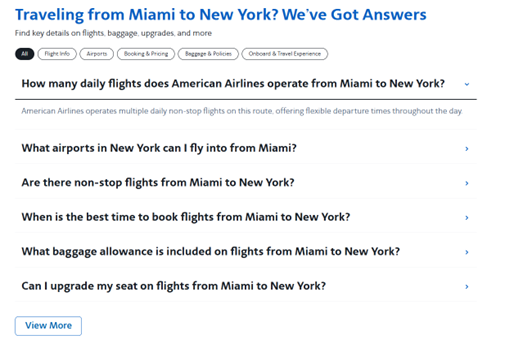
OTAs Have Turned FAQs Into Flight-Information Modules
The strongest competitor FAQs do more than repeat evergreen travel advice. They combine several types of evidence on one page:
- Commercial facts, including one-way and round-trip prices, typical price ranges, and cabin-specific fares.
- Operational facts, including flight duration, route distance, nonstop availability, schedules, and weekly frequency.
- Airport facts, including airport names, IATA codes, nearby alternatives, and sometimes terminals.
- Booking insights, including the cheapest month, cheapest day, and recommended advance-purchase window.
- Airline and itinerary facts, including carriers on the route, aircraft, cabin options, and connection details.
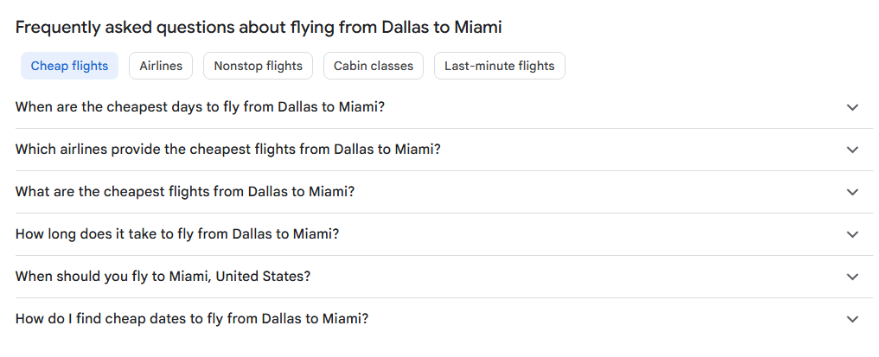
Consider the contrast between generic and route-specific content.
“Book early for lower fares” could appear on almost any travel page. “The best booking window for this route is approximately [X] days before departure” answers a real question with a claim that can be checked, refreshed, and attributed to a source.
The same is true for “flight schedules vary” versus “[airline] currently operates approximately [weekly frequency] nonstop flights per week from [origin] to [destination].”
The FAQ format is useful because it converts structured facts into complete, self-contained statements. The question supplies intent and context, and the answer supplies the evidence. Together, they provide a traveler with a quick answer and a retrieval system with a clearly labeled passage to evaluate.
The Airline FAQ Challenge Has Three Parts
At airline scale, FAQ creation is not primarily a writing problem. It is a content operations problem with three distinct requirements.
1. Relevance
The question must belong on the page.
A destination page can sensibly answer which airports serve Miami, when flights to Miami are typically cheapest, and which origin cities offer nonstop service. A New York-to-Miami route page can answer flight time, weekly frequency, typical price, aircraft, and whether the service is nonstop or connecting.
Publishing the same generic list on both pages may be easy, but it ignores the page’s purpose. A scalable system should vary the question set by template and only use questions the page can answer well.
2. Accuracy
The answer must resolve from a trusted source and remain true for the page.
Route facts change on different clocks. Airport codes are relatively stable. Schedules and flight frequency change more often. Fares and booking insights may change daily or seasonally. Baggage and cabin policies may depend on market, fare family, aircraft, or operating carrier.
This makes a blank field more than a cosmetic problem. If a system cannot confirm a fact, it should suppress the FAQ, use an approved fallback, or route it for review. It should never publish an empty placeholder, invent a value, or allow an old answer to persist simply because the question is popular.
3. Scale
The system must produce distinct answers without requiring a writer to manually maintain every page.
An airline may have thousands of origin-to-destination and destination landing pages, multiplied across languages and markets. Even a modest set of ten questions per page quickly becomes tens of thousands of answers. Manual authorship does not fail because content teams lack ideas, but because the review-and-refresh burden grows faster than the team.
Templates solve the repetition problem only when they are connected to page context and reliable facts. Otherwise, automation reproduces generic copy faster.
FAQs Are Not a Shortcut or a Schema Trick
It is tempting to justify FAQs with structured data alone. That is the wrong business case.
Schema.org still defines `FAQPage` as a page that contains one or more frequently asked questions, and accurate structured data can provide explicit clues about the page’s content. But Google has now deprecated FAQ rich results in Search. As Search Engine Journal reported in May 2026, the feature no longer produces visible FAQ results in Google Search, and Google subsequently removed its FAQ rich-result documentation. FAQ markup can remain on a page, but it should not be treated as a path to an enhanced search appearance.
The durable value is the visible answer itself.
Google’s current guidance for generative AI search (a.k.a. GEO) is the same as its guidance for traditional Search Engine Optimization (SEO): publish useful, original, people-first content in a clear technical structure. It warns against creating large volumes of low-value variations primarily to influence rankings or AI responses.
For airline teams, that creates a simple test: would this answer still help a traveler if search engines did not exist?
If the answer is yes—because it explains when to book, which airport is used, how long the flight takes, or whether a nonstop option exists—the FAQ has earned its place. Search and AI visibility are a consequence of making that information useful, accessible, and specific.
A Three-Layer Model for Dynamic Airline FAQs
A robust Dynamic FAQ separates editorial intent from page context and source data.
| Layer | What it controls | Example |
|---|---|---|
| Question and answer pattern | The traveler need, wording, caveats, and approved response structure | “When is the best time to book a flight from [origin] to [destination]?” |
| Page context | The airline, origin, destination, airports, market, language, and page type | [airline], [origin], [destination], [IATA codes] |
| Flight fact | The value that makes the answer unique and verifiable | Cheapest booking window, flight duration, weekly frequency, cheapest month |
This separation changes the workflow.
A content team can approve the tone and logic once: how a booking-window answer should be phrased, when a caveat is required, and how long the answer should be. The page supplies the route context. A flight-fact service supplies the value. The rendering layer combines them only when all required inputs are available.
For example:
Template question: When is the best time to book a flight from [origin] to [destination]?
Template answer: Based on recent fare patterns, travelers may find lower prices by booking approximately [booking window] before departure. Prices can change with the season, demand, and travel dates, so compare prices for nearby dates before booking.
The editorial structure remains consistent, but the route and fact make the answer specific. The caveat keeps the claim appropriately scoped. If the booking-window fact is unavailable, the entire item is omitted rather than weakened into generic filler.
How airTRFX Operationalizes the Model
This is the problem the airTRFX Dynamic FAQ is designed to solve.
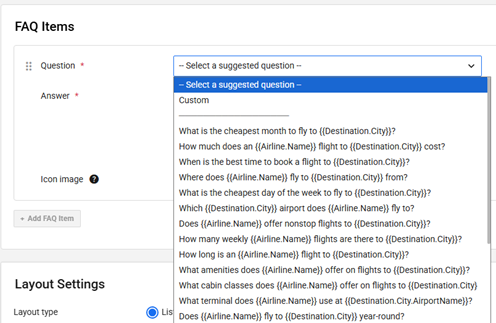
Content teams can select from reusable question patterns or create their own, then author answers with page-level context variables and available flight facts. Variables resolve the airline, origin, destination, airports, location, language, and other page context. Dynamic facts can populate answers about topics such as the cheapest month, average pricing, airports, time zones, and nearby airports; as the flight-fact library expands, the same framework can support route duration, booking windows, flight frequency, connections, seasonality, aircraft, and amenities, subject to template and data availability.
The same fact layer can also support the Quick Facts Widget. That lets a page show a concise value at a glance and explain it in full without asking the content team to maintain two separate versions of the truth.
Several implementation details are more important than the accordion design:
- Server-side rendering: FAQ content is written into the initial HTML so crawlers do not have to depend on client-side JavaScript to discover it.
- Graceful suppression: when a required variable or fact cannot be resolved, the FAQ item is hidden as a complete unit. The traveler does not see a broken question or empty answer.
- Reusable content logic: content managers can author and govern question-and-answer patterns once, then apply them across eligible templates instead of maintaining every page independently.
- Crawlable pagination: a “View More” interaction can keep the visible page concise while the underlying FAQ content remains available in the server-rendered HTML.
- Browsable categories: larger FAQ libraries can be organized around topics such as fares, schedules, airports, baggage, day-of-travel, and loyalty so users can find the right answer quickly.
- Multi-language support: configurations can be localized while route variables and dynamic values resolve for the relevant edition and market.
The result is not “unique” because a city name was swapped into identical boilerplate. It is unique when the answer reflects a different route fact, airport set, service pattern, season, or booking insight—and when the question is relevant to that page.
What Airlines Should Automate First
The first release should not attempt to answer everything.
Start with questions that are both common in flight search results and supported by reliable data. For destination pages, that usually means:
- What is the cheapest month to fly to [destination]?
- Which airport does [airline] use in [destination]?
- Does [airline] offer nonstop flights to [destination]?
- Where does [airline] fly to [destination] from?
- How far in advance should travelers book [airline] flights to [destination]?
For city-to-city pages, prioritize:
- How long is the flight from [origin] to [destination]?
- How much do flights from [origin] to [destination] typically cost?
- What is the cheapest month to fly from [origin] to [destination]?
- Does [airline] offer nonstop flights from [origin] to [destination]?
- How many flights does [airline] operate each week from [origin] to [destination]?
- Which airports does [airline] use for flights from [origin] to [destination]?
- What connecting options does [airline] offer from [origin] to [destination], and where is the layover?
Each question should have a named source, an availability rule, and a fallback decision before it is released. Questions that depend on airline policy (e.g., baggage, seat upgrades, miles, cancellation, or cabin entitlements) should use governed policy content rather than a route-data shortcut.
A Quality Standard for Dynamic FAQs
Before a Dynamic FAQ is published at scale, it should pass six checks:
- Useful: The answer helps a traveler make or prepare for a flight decision.
- Specific: It contains enough route, airline, airport, time, or price context to stand on its own.
- Sourced: Every dynamic claim maps to a known system of record.
- Current: Volatile facts have a refresh cadence, scope, and caveat.
- Complete: Missing inputs suppress the item or trigger an approved fallback.
- Accessible: The visible answer and any matching structured data are consistent, server-rendered, and available to crawlers that are permitted to access the page.
Answer length matters, too. In most cases, roughly 30 to 70 words is enough to answer the question, explain a condition, and avoid turning an accordion into a wall of text.
This governance is what separates scalable content from scaled content abuse. The objective is not to manufacture more pages or keyword variations. It is to expose useful first-party information where travelers already need it.
Conclusion
Airlines do not have to outwrite every OTA page by page. They need a better system for turning their own data and policies into answers.
The Dynamic FAQ is valuable because it connects three things that are usually managed separately: editorial standards, page context, and flight facts. When those layers work together, an airline can answer route-specific questions across thousands of pages without asking a content team to write and refresh thousands of isolated documents.
That can improve the traveler experience first. It can also make airline pages stronger sources for traditional search and AI assistants by publishing concise, accessible evidence about the questions that appear in flight-search answers.
Publishing an FAQ does not guarantee greater search visibility or an AI citation. But there is a clear way to stop leaving the answer to someone else: publish the fact, frame it around the traveler’s question, keep it current, and make it retrievable.
Dynamic Airline FAQs: Frequently Asked Questions
FAQs convert flight facts and policy information into direct answers to traveler questions. On destination and route pages, they can explain price, flight duration, nonstop availability, frequency, airports, seasonality, booking windows, and other decision-making information in an easy-to-scan, easy-to-interpret format.
FAQPage markup can describe visible question-and-answer content, but Google deprecated FAQ rich results in May 2026. Airlines should treat structured data as an accurate representation of visible content, not as the reason for creating the content or as a guarantee of improved search visibility.
Use reusable question-and-answer patterns connected to page context and trusted flight facts. The system should resolve variables such as airline, origin, destination, and airport, populate approved facts, render the answer server-side, and suppress the entire item when required data is missing.
airTRFX enables content teams to configure reusable or custom questions and variable-enabled answers across eligible pages. It resolves page context and available flight facts, renders content server-side, supports concise layouts and navigation, and gracefully hides unresolved items so travelers do not see incomplete answers.