
Flight Page Completeness Goes Beyond Fare Coverage
For airline flight pages, completeness is not only a word-count or fare-availability problem. It is a route information coverage problem.
A page may show a booking form, a selection of fares, and a short paragraph about the destination. Yet it may still leave the route itself largely uncovered. How long is a nonstop flight? Does the airline operate the route every day? Which airports are used? Are connections available? What is a typical layover? When are fares generally lower? Together, these details make the page more complete for users and give search engines and AI assistants clearer route information to interpret.
Online Travel Agencies (OTAs) and flight aggregators have already established this expectation. Their route pages commonly combine live fares with duration, nonstop availability, airports, seasonal pricing patterns, typical price ranges, and direct answers to common questions. The lesson for airlines is not to copy every module from an OTA, but to recognize that a useful route page requires more than just a booking form and a few fares.
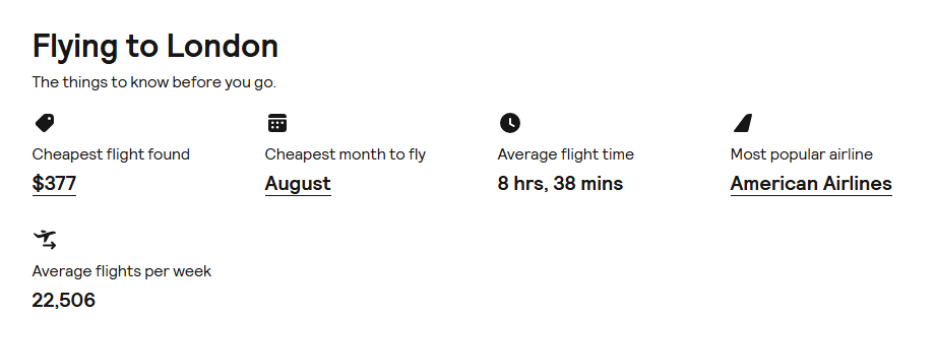
Airlines already possess much of the underlying information. The opportunity is to turn that data into accurate, readable, and consistently governed page content.
The Search Visibility Problem Is Also an Information Problem
In PROS research covering 376 city-to-city flight prompts, ChatGPT frequently mentioned airlines but often linked to OTAs and flight aggregators whose pages provided broader route information. The pattern was especially visible in topics related to flight facts.
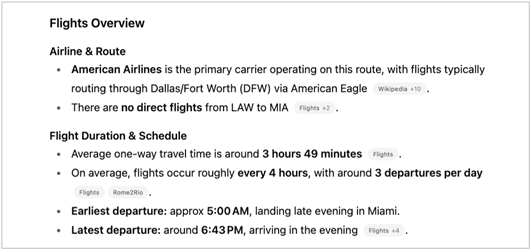
This does not mean that publishing a duration or frequency will automatically produce a citation. It does suggest a structural disadvantage: when an airline page does not provide enough route evidence, a search or AI system may need another source to complete the answer.
Traditional SEO and GEO overlap here. Google’s guidance for succeeding in AI search experiences continues to emphasize the foundations of search: accessible pages, clear organization, accurate information, and people-first content. Its helpful-content guidance also asks whether a page provides a substantial, complete, and trustworthy description of its topic.
Flight facts describe the route or itinerary, including duration, distance, frequency, airports, and connections. Booking insights interpret observed pricing or seasonality patterns, such as the historically cheapest month or a typical booking window. Together, these can help an airline page meet that standard by providing route-specific information rather than generic travel copy.
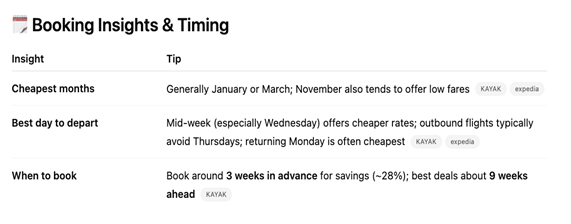
For search engines, that information clarifies what the page covers and supports more specific route queries. For AI systems, it provides concise passages and values that can be retrieved and summarized. For travelers, it makes the page more useful.
The Hard Part Is the Data System Behind the Page
Publishing route information at airline scale requires more than authoring hundreds of facts and insights by hand. Each data point needs an agreed definition, source, scope, and publishing rule.
A governed fact should have:
- A definition: What exactly is being measured?
- A source: Does it come from schedules, FareNet, historical pricing data, airport data, or airline-provided content?
- A scope: Which route, direction, cabin, trip type, date range, or itinerary does it describe?
- A refresh schedule: How often can the value change, and when should it be recalculated?
- A fallback: Should the fact be hidden, replaced with airline-authored content, or displayed with a broader statement when data is unavailable?
- A localization rule: How should units, dates, currency, and surrounding labels change by market and language?
Different facts move on different clocks. Airport codes and route distance are relatively stable. Schedules, frequency, and terminals can change by season. Connections and layover duration vary by itinerary. Current fares may change throughout the day. Historical booking insights should be recalculated using the same methodology that produced them.
One universal refresh cadence cannot manage all of this reliably.
Consistency across components matters just as much as freshness. For example, if a Quick Facts module says one month is the cheapest while an FAQ says another, the page has introduced a factual inaccuracy.
When a reliable value is unavailable, graceful suppression is usually preferable to an empty field, a placeholder, or an outdated number that still looks current.
One Trusted Data Layer Can Support Several Useful Formats
Travelers do not consume every type of information in the same way. The page should draw from a consistent data layer while adapting the presentation to the job each component performs.
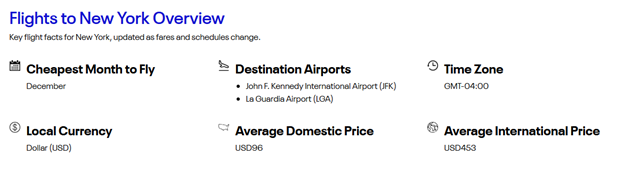
A scannable Quick Facts area can summarize the route:
- Typical nonstop duration: [duration]
- Route distance: [distance]
- Nonstop service: [frequency]
- Origin and destination airports: [airport codes]
- Historically lower-priced month: [month]
Contextual route copy can explain a fact that needs nuance:
“[Airline] operates nonstop service from [origin airport] to [destination airport]. Flights typically take approximately [duration], although schedules and operating conditions can affect travel time.”
A Dynamic FAQ can answer the same topic directly:
“How long is a nonstop flight from [origin] to [destination]?”
“A nonstop flight from [origin] to [destination] typically takes approximately [duration]. Actual travel time may vary by schedule and operating conditions.”
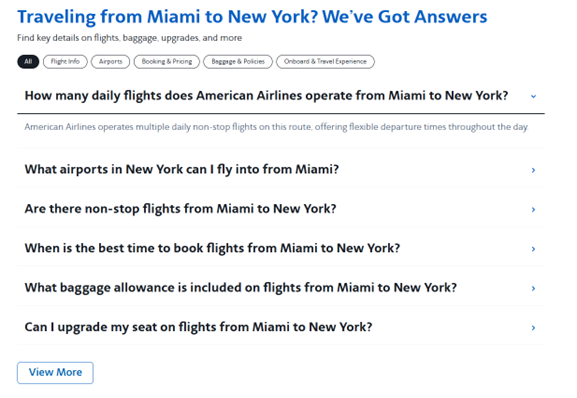
This approach also avoids using FAQs as a repository for information that belongs elsewhere on the page. Core facts should be visible in the main route experience. FAQs can restate selected facts in a question-and-answer format when that format helps the traveler.
How airTRFX Can Help Airlines Scale Flight Facts and Booking Insights
The airTRFX Quick Facts Widget provides a configurable container for concise route and destination information. It can combine data-driven facts with airline-defined custom facts, localize dynamic values, and render content in a crawlable page experience. When a dynamic value is unavailable, the component can suppress it rather than displaying broken or empty content.
That presentation layer is only one part of the value. The broader opportunity is to connect governed facts to several airTRFX components:
- Quick Facts for scannable route and booking information
- Dynamic FAQs for contextual questions and answers built from the same variables
- Connections DPA for fare and itinerary details such as the connecting airport, layover duration, stops, and total travel time
- Route content that explains service patterns and booking insights in natural language
Flight fact and booking insight availability will vary by airTRFX package, page template, data source, configuration, and rollout status. Planned or phased capabilities may include route duration and distance, flight frequency, connection details, average route pricing, the cheapest month and day, booking window, seasonality, aircraft, amenities, and other route attributes.
Here is just a sample of flight facts and booking insights we will be gradually releasing:
| Flight Facts (Sample) | Source | Availability |
|---|---|---|
| cheapest_month_to_fly | Included | Available now! |
| destination_airports_names | Included | Available now! |
| departure_timezone | Included | Available now! |
| arrival_timezone | Included | Available now! |
| average_price_domestic_flights | Included | Available now! |
| average_price_international_flights | Included | Available now! |
| flight_duration | FareNet – Requires Collection | Q3 |
| route_cheapest_month_to_fly | Included | Q3 |
| route_cheapest_day_to_book | Included | Q3 |
| cheapest_booking_window | Included | Q3 |
| iata_code_connecting_airport | FareNet – Requires Collection | Q3 |
| layover_duration | FareNet – Requires Collection | Q3 |
| high_season_month | Included | Q3 |
| low_season_month | Included | Q3 |
The goal is not to place every available data point on every page. It is to give airlines a scalable way to select the facts that improve a particular route experience while keeping their definitions and values consistent.
A Practical Publishing Standard
Before a flight fact or booking insight goes live, an airline should be able to confirm:
- Usefulness: Does this information help a traveler understand or compare the route?
- Specificity: Is the city, airport pair, itinerary, cabin, and trip type clear where relevant?
- Accuracy and freshness: Is the value generated accurate and current?
- Consistency: Does the same fact mean the same thing in Quick Facts, route copy, fares, and FAQs?
- Resilience: Will the page hide or replace the value cleanly when data is unavailable?
- Accessibility: Is the information present as readable page content rather than trapped in an image or inaccessible interaction?
This standard is more important than the number of facts published. Six well-defined route facts can create more value than 20 ambiguous values.
Better Flight Pages Start with Better Data
Airline flight pages do not need more generic copy. They need a stronger layer of first-party route information.
Flight facts explain what the journey is: where it operates, how long it takes, how frequently it runs, and what nonstop or connecting options look like. Booking insights help travelers interpret fare and seasonality patterns.
Together, they make flight pages more complete for travelers and more informative for search systems. They can support traditional SEO by expanding the page’s route-specific relevance and support AI search by providing clear information that can be retrieved and summarized.
airTRFX can help operationalize that model through Quick Facts, Dynamic FAQs, fare displays, connection details, and reusable contextual variables. But the durable advantage is not solely the widget. It is the airline’s ability to publish accurate, consistent, and genuinely useful route information at scale.
Frequently Asked Questions
The most useful facts commonly include the origin and destination airports, route distance, typical nonstop duration, flight frequency, nonstop availability, and relevant connection details. The exact selection should reflect the route, the airline’s service, and the reliability of the available data.
A flight fact describes a route, schedule, airport, or itinerary, such as distance or layover duration. A booking insight interprets a set of fare or demand observations, such as the historically cheapest month or a typical booking window.
The cadence should match the data. Stable airport and distance facts may require infrequent review, while schedules, frequency, fares, and connections may change much more often. Historical booking insights should be recalculated according to their defined observation window.
Yes. A shared fact layer can support multiple page components as long as each component preserves the same definition, scope, and qualification. This reduces contradictory answers and allows the information to be presented in the format most useful to the traveler.