
In our Nov 4, 2026 crawl of nearly 30,000 US flight searches, 7 in 10 Google AI Mode answers linked only to Google Flights, and fewer than 1 in 7 linked an airline site.
In Part I, Part II, and Part III of our Google Flights indexing series, we looked at Google Flights as a website competing with airlines and OTAs in organic search. Google AI Mode adds a new place where that competition plays out: the answer itself.
On Nov 3, 2026, Search Engine Roundtable reported that the AI Mode flight answers it tested linked only to Google Flights. Our Nov 4 crawl lets us check that claim at scale and put it in context. This article looks at Google Flights as a website, meaning links to google.com/travel/flights pages, not the Google Flights box that Google shows at the top of regular search results.
Two searches from our keyword set show what this looks like. Both linked only to Google Flights in our Nov 4 crawl.
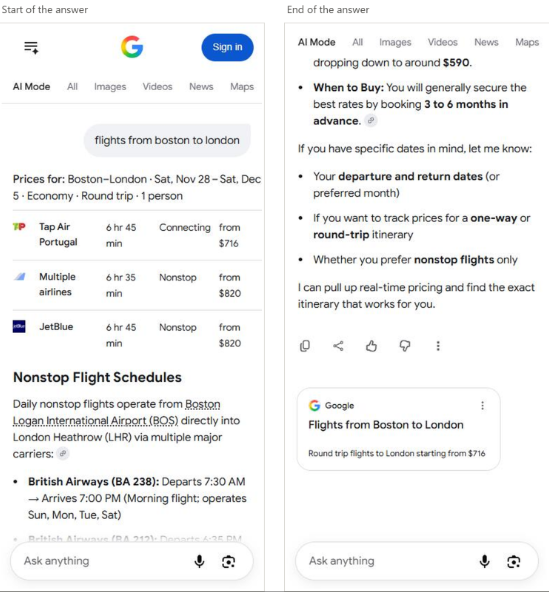
Google AI Mode answer to “flights from boston to london,” US, mobile. Its only source is a Google Flights search.
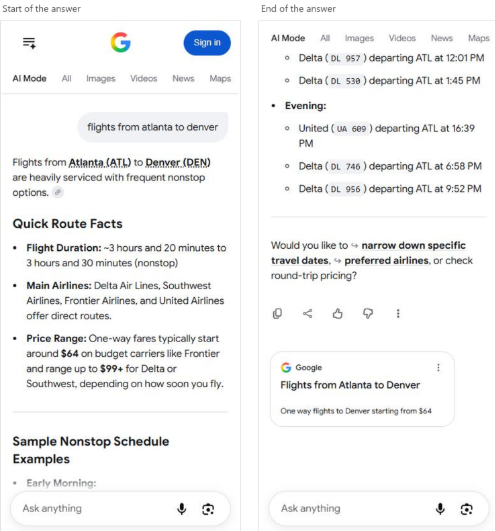
Google AI Mode answer to “flights from atlanta to denver,” US, mobile. It names four airlines but links only to Google Flights.
Methodology Recap
- Searches: Google AI Mode on google.com, United States (country level, no specific city), English, mobile, tracked with Advanced Web Ranking (AWR).
- Keywords: 29,887 non-branded flight searches tracked at every crawl since Apr 20, 2026, such as “flights from miami to chicago” and “flights from atlanta.” None of them name an airline.
- Crawls: Eight: Apr 20, Jun 10, Jul 1, Aug 5, Sep 2, Sep 30, Oct 7, and Nov 4, 2026. AI Mode returned an answer for more than 99% of the keywords in every crawl, and every answer is counted.
- Links: Every link in an answer counts, whether it sits inside the text or in the list of sources; a page linked more than once in the same answer counts once. Google Flights means any link to a google.com/travel/flights page.
- Reading the data: Results depend on how well AWR captures each answer and its links, and AI Mode answers change a lot from one crawl to the next, so read the direction across crawls rather than any single crawl’s level.
All KPIs below count every answer, including answers with no links. The Citation Rate is the Overall Citation Rate from our KPI framework, applied to Google Flights and to airline sites.
| KPI | Calculation | What it shows |
|---|---|---|
| Google Flights Citation Rate | Answers with at least one link to Google Flights ÷ all answers | How often Google Flights is linked at all |
| Google Flights–Exclusive Answers | Answers where every link goes to Google Flights ÷ all answers | How often Google Flights is the only site linked |
| Google Flights Citation Share | Links to Google Flights ÷ all links, across all answers | Google Flights’ weight against every other site |
| Airline Citation Rate | Answers with at least one link to an airline site ÷ all answers | How often travelers see any airline linked |
| Citation share by site type | Links to each type of site ÷ all links, across all answers | Who receives the links: Google Flights, OTAs, airlines and others |
Google Flights Went From Linked to Linked Alone
Google Flights has been a fixture of AI Mode flight answers since we started tracking. On Apr 20, 84% of answers linked to it, and the Citation Rate stayed between 84% and 96% in every crawl since. On Nov 4, it was 88%. Being linked was never the issue for Google Flights.
Google Flights was always linked. On Nov 4, it was often the only site linked
Share of AI Mode answers, US, Apr 20 to Nov 4, 2026. Numbered lines mark Google announcements (listed below)
- 1May 6, 2026: Google adds more links inside AI responses, next to the text they support (Google)
- 2May 19, 2026: Gemini 3.5 Flash becomes AI Mode’s default model for everyone (Google I/O) (Google)
- 3Aug 27, 2026: AI Mode adds Google Flights price tracking and shows flight options with current prices (Google)
- 4Oct 15, 2026: Google adds more in-text links and shows them higher in answers (Google)
Show the data
| Crawl | Google Flights Citation Rate | Google Flights-Exclusive Answers |
|---|---|---|
| Apr 20 | 84.4% | 31.3% |
| Jun 10 | 93.6% | 11.4% |
| Jul 1 | 93.4% | 7.2% |
| Aug 5 | 95.8% | 0.5% |
| Sep 2 | 87.0% | 4.6% |
| Sep 30 | 91.2% | 64.0% |
| Oct 7 | 87.4% | 5.2% |
| Nov 4 | 88.4% | 70.6% |
What changed is that Google Flights is now often the only site linked. On Apr 20, 31% of answers linked only to Google Flights. From June to early September, that share fell to 11% or less (under 1% on Aug 5), as answers linked to OTAs and airlines alongside it. Then it swung: 64% on Sep 30, 5% on Oct 7, and 71% on Nov 4.
The two high crawls have something else in common. Answers on Sep 30 and Nov 4 carried fewer links, about 2 per answer, against 3 to 8 in every other crawl. In other words, when AI Mode shortened its list of links, it kept Google Flights and dropped the rest. Search Engine Roundtable’s report from the same week matches what we saw on Nov 4.
Google Flights Took 71% of the Links on Nov 4
Looking at links instead of answers points the same way for Google Flights. On Apr 20, Google Flights received 30% of all links, OTAs and metasearch sites 34%, and airlines 21%. Through Oct 7, Google Flights’ share ranged from 22% to 57%, while OTAs’ share ranged from 17% to 50%. On Nov 4, Google Flights received 71% of all links, OTAs 5% and airlines 17%.
On Nov 4, Google Flights received 71% of all links in AI Mode answers
Share of all links in AI Mode answers (in-text and sources), by type of site, US, Apr 20 to Nov 4, 2026
Show the data
| Crawl | Links | Google Flights | OTAs and metasearch | Other | Flight info and route sites | Airlines |
|---|---|---|---|---|---|---|
| Apr 20 | 169,761 | 29.9% | 34.4% | 5.0% | 9.4% | 21.3% |
| Jun 10 | 99,982 | 37.3% | 31.1% | 1.7% | 2.7% | 27.2% |
| Jul 1 | 113,241 | 37.8% | 30.5% | 2.1% | 3.3% | 26.3% |
| Aug 5 | 234,982 | 24.6% | 49.5% | 4.3% | 6.0% | 15.5% |
| Sep 2 | 212,996 | 22.3% | 48.4% | 10.2% | 12.8% | 6.2% |
| Sep 30 | 69,010 | 56.8% | 16.6% | 5.2% | 3.9% | 17.6% |
| Oct 7 | 127,983 | 38.2% | 31.9% | 4.2% | 11.7% | 13.9% |
| Nov 4 | 50,798 | 70.9% | 5.4% | 4.7% | 1.8% | 17.3% |
Site by site, OTAs, metasearch and flight info sites lost most of their share, while the largest airline sites held smaller but steadier shares:
| Site | Type | Apr 20 | Oct 7 | Nov 4 |
|---|---|---|---|---|
| google.com/travel/flights | Google Flights | 29.9% | 38.2% | 70.9% |
| expedia.com | OTA | 7.5% | 14.6% | 3.3% |
| skyscanner.com | Metasearch | 8.2% | 6.9% | 0.7% |
| kayak.com | Metasearch | 4.0% | 3.1% | 0.3% |
| flightsfrom.com | Flight info | 2.8% | 4.1% | 0.6% |
| Airline A | Airline | 5.3% | 4.1% | 3.9% |
| Airline B | Airline | 4.3% | 4.2% | 3.1% |
| Airline C | Airline | 2.9% | 1.4% | 2.9% |
| Airline D | Airline | 2.5% | 0.8% | 0.9% |
Share of all links in Google AI Mode answers (in the text and in the sources), US, Apr 20, Oct 7, and Nov 4, 2026. Airline names are anonymized.
The shift is not steady. OTAs had their largest shares in August and September (50% and 48% of all links), and on Oct 7 they still received 32%. The Nov 4 numbers mark a sharp break, not the end of a gradual slide. Airlines’ share was higher on Nov 4 than on Oct 7 (17% against 14%) only because so few other links remained: the number of airline links fell by about half, and fewer answers linked an airline at all.
Fewer Answers Link to Airlines
For airlines, the question is simpler: does the answer link to an airline site at all? On Apr 20, 48% of answers did. That rose to 64% by Aug 5, then fell to 30% on Sep 2 and 19% on Sep 30, recovered to 44% on Oct 7, and dropped to 14% on Nov 4.
On Nov 4, few AI Mode answers linked an airline or an OTA
Share of AI Mode answers linking at least one site of each type, US, Apr 20 to Nov 4, 2026. Numbered lines mark Google announcements (listed below)
- 1May 6, 2026: Google adds more links inside AI responses, next to the text they support (Google)
- 2May 19, 2026: Gemini 3.5 Flash becomes AI Mode’s default model for everyone (Google I/O) (Google)
- 3Aug 27, 2026: AI Mode adds Google Flights price tracking and shows flight options with current prices (Google)
- 4Oct 15, 2026: Google adds more in-text links and shows them higher in answers (Google)
Show the data
| Crawl | Airline Citation Rate | OTA Citation Rate |
|---|---|---|
| Apr 20 | 48.5% | 52.3% |
| Jun 10 | 57.4% | 68.9% |
| Jul 1 | 62.6% | 73.8% |
| Aug 5 | 64.0% | 96.8% |
| Sep 2 | 30.4% | 87.2% |
| Sep 30 | 19.0% | 22.3% |
| Oct 7 | 44.2% | 80.1% |
| Nov 4 | 13.6% | 7.8% |
OTAs and metasearch sites moved the same way, only further. They were linked in 97% of answers on Aug 5 and 80% on Oct 7, but in 8% on Nov 4. On Nov 4, airlines were linked in more answers than OTAs, but both were far behind Google Flights.
What This Means for Airlines
In ChatGPT, we found that answers name airlines but provide links to OTAs and aggregators (see Mentioned but Unlinked). Google AI Mode favors Google’s own flight product instead. On Nov 4, OTAs were cited in only 8% of answers, down from 80% on Oct 7, even though their flight pages already carry the fares, flight facts, and booking insights we recommend to airlines. Better pages alone will not win back links that AI Mode keeps for Google Flights.
They still matter. In seven of our eight crawls, OTAs were linked in more answers than airlines, including 80% against 44% on Oct 7. That fits the idea that complete flight pages win citations when AI Mode looks beyond Google Flights. Only on Nov 4, when Google Flights took most of the links, did airlines edge ahead (14% against 8%), and AI Mode has switched between these patterns from one crawl to the next.
Our airline playbook groups that work into seven pillars. Early results from a separate study we are running on the same Nov 4 answers, which reads each answer sentence by sentence, support them. AI Mode named at least one airline in nearly 9 in 10 answers but linked the named airline’s own site for only about 1 in 10 of those mentions. We note other early results under the pillars they support:
- If the route exists, the page must exist. Publish an indexable page for every origin-destination pair you fly. In AI Mode, nearly 9 in 10 OTA links went to a page for that specific route, against about half of airline links; most other airline links went to a homepage.
- Make every fare findable. Render fares in the initial HTML and label each one with its route, trip type, and cabin, so any AI system can read it (see The Fare Citation Gap). AI Mode quoted a price in nearly 9 in 10 answers.
- Deliver full-spectrum fare coverage. Show one-way and round-trip, direct and connecting, cabin, last-minute and promotional fares, by month and by day.
- Provide rich flight facts and booking insights. Nonstop and connecting options, flight time, layovers, airports, frequency, distance, and when to book. AI Mode stated nonstop availability, connections, and flight time in more than 8 in 10 answers. For those facts, it cited flight information sites with a page for every route, such as flightsfrom.com, as often as it cited airlines (see Building AI-Ready Flight Pages).
- Turn FAQs into accurate, structured content. Answer common traveler questions for each route from live data, not generic copy.
- Offer practical information. Airports, seasonality, cabin options, amenities, and basic policies that fare-only pages lack (see Fares Alone Don’t Make a Flight Page).
- Allow access to crawlers. AI Mode draws on Google’s search index, so make sure Googlebot can crawl your route pages, and that robots.txt and firewall rules do not block AI agents such as ChatGPT-User and OAI-SearchBot.
airTRFX covers pillars 1 to 6 on airline sites: it creates an indexable page for every route, renders fares server-side across trip types and dates, and adds flight facts, booking insights, dynamic FAQs and destination information to each page. Pillar 7 is a setting on your own servers.
Then measure the result: track your Overall Citation Rate next to Google Flights’ (see our KPI framework), read the trend across crawls rather than any single crawl, and pair citations with referral sessions and bookings.
Conclusion
On Nov 4, Google AI Mode answered most US flight searches with Google Flights alone. Seven in 10 answers linked only to Google Flights, which received 71% of all links. Only 14% of answers linked an airline site, and 8% linked an OTA. Airlines were named in nearly 9 in 10 answers, but their own sites were rarely the ones linked.
Airlines should not wait to see whether this pattern holds. Implementing our AI search recommendations, starting with the seven pillars above, puts their route pages in position to be cited whenever AI Mode looks beyond Google Flights. We will continue to track these searches in future crawls and report whether the Nov 4 pattern holds.